In short
- Less snoring is the best-supported claim. In a 2022 study, 13 of 20 mouth breathers cut their snoring at least in half after a week of taping.
- Claims about dry mouth, fresher breath and healthier teeth are plausible but, according to Sleep Foundation, mostly haven't been studied.
- There's no scientific evidence that mouth taping sharpens the jawline, and a 2025 review found the data don't support it for sleep apnea.
- The FTC says health research should be relevant to the specific product and the specific benefit being advertised.
- FDA says there are no federal standards or definitions for the word hypoallergenic on cosmetics.
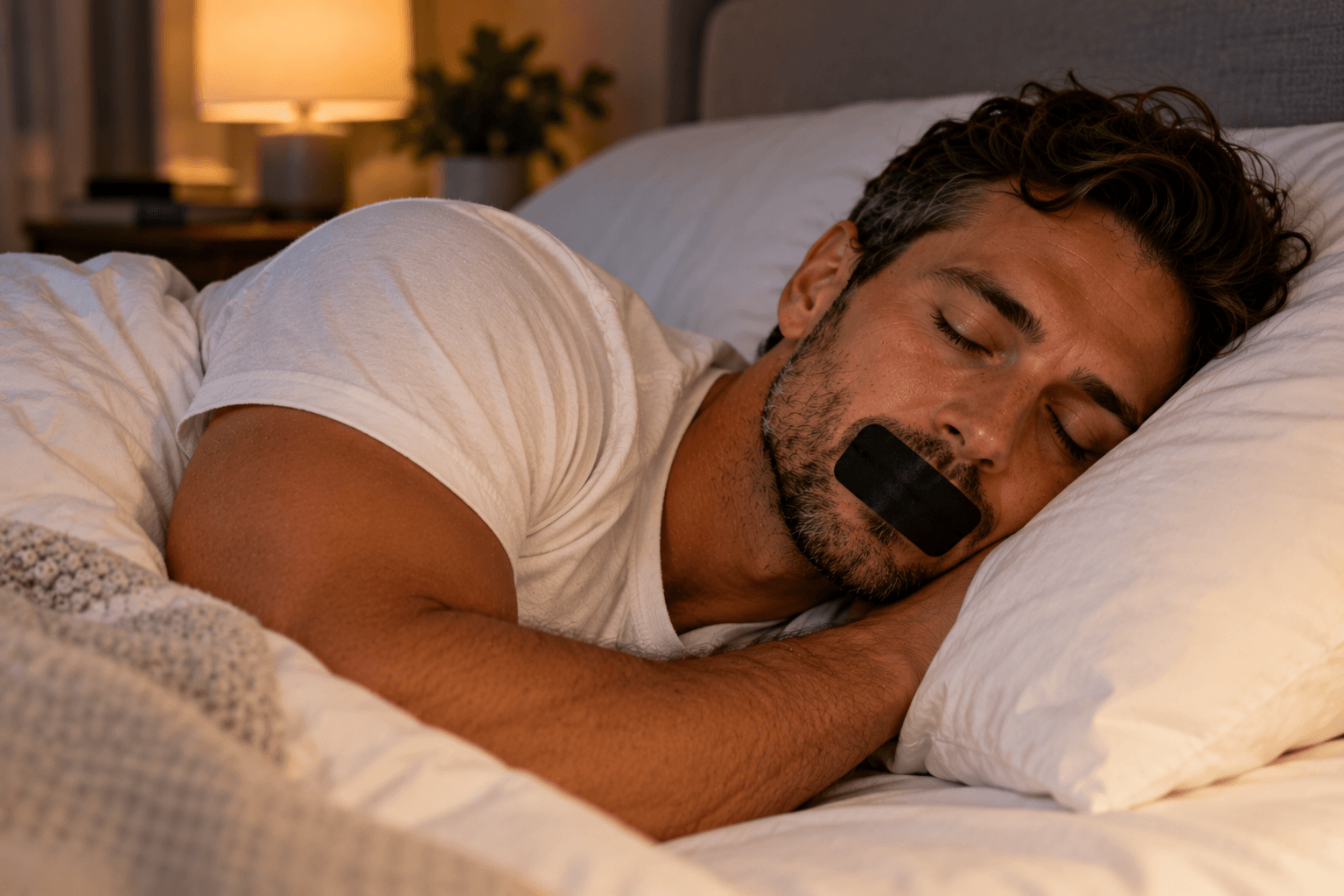
Some mouth tape marketing claims have real research behind them, and some don't yet. Less snoring in people who breathe through their mouths at night is the best-supported claim. Dry mouth and fresher breath are plausible but mostly untested, while a sharper jawline and sleep apnea relief aren't supported at all.
That's worth knowing because a lot of what you see comes from sellers. A 2026 study of 390 Instagram reels tagged #mouthtape found 55.4% were posted by companies, and the authors found commercial and medical claims far outnumbered evidence-based information. Here's how eight common claims hold up, starting with the strongest.
Which mouth tape claims have research behind them?
"Reduces snoring"
Research: limited (what this means)Reducing snoring is the claim with the most support, and the results so far are encouraging. In a 2022 study of 20 adults who breathed through their mouths and had mild sleep apnea, the median snoring index fell from 303.8 to 121.1 events an hour after a week of taping. Thirteen of the 20 cut their snoring by at least half. A 2015 pilot study using a porous patch over the mouth found the median snoring index fell from 146.7 to 40 an hour in 30 people with the same profile.
A 2025 systematic review in PLOS One noted that all three studies that measured the snoring index found a significant drop. What to read carefully is who was studied. These were small groups of mouth breathers with mild sleep apnea, and neither study had a placebo group. Our article on whether mouth tape helps snoring covers the details.
"Helps you sleep better"
There's a hint of support for the claim that mouth tape helps you sleep better. In the 2015 pilot study, scores on the Epworth Sleepiness Scale, a standard measure of daytime sleepiness, fell from 8.1 to 5.2 while people wore the mouth patch. Sleep Foundation says small studies suggest mouth taping may reduce daytime fatigue in people with mild sleep apnea.
What hasn't been shown is that tape improves sleep for people in general. The 2024 scoping review in the American Journal of Otolaryngology found better sleep was one of the most common benefits claimed in TikTok videos, and said few of those claims had been evaluated. Plenty of people say they sleep better with tape, and that may be true for them. Ads that promise better sleep for everyone are going further than the studies.
Which claims are plausible but untested?
"Stops dry mouth"
Stopping dry mouth is one of the most common reasons people try mouth tape, and the logic is sound. A 2009 trial in Respiratory Medicine starts from the point that nose breathing makes sure inhaled air is warm, filtered and moist. Keeping the mouth closed should, in theory, keep it from drying out overnight.
Sleep Foundation lists dry mouth among the claims that haven't been scientifically studied. If you wake up parched after sleeping with your mouth open, it's a sensible thing to try, as long as your nose is clear. Our guide to mouth tape for dry mouth goes further.
"Fresher breath and healthier teeth"
Oral health was one of the two most common benefits claimed on TikTok, according to the scoping review, and the 2026 Instagram study found reels claiming mouth taping prevents cavities and gum disease. Sleep Foundation says proponents link mouth breathing to bad breath, cavities and gum disease, but that most of these claims haven't been scientifically studied.
We didn't find a study that tested mouth tape for bad breath or dental health. Our article on whether mouth breathing causes bad breath covers what's known about the link itself.
"Boosts nitric oxide"
The nitric oxide claim starts from real research. A 1995 study in Nature Medicine found nitric oxide is produced in the paranasal sinuses and is present in air from the nasal airways. That's often cited as a reason nose breathing beats mouth breathing.
The gap is the next step. We couldn't find a study measuring whether mouth tape changes how much nitric oxide you breathe in at night, or whether that would have a health effect. Treat this claim as unproven for now. Our explainer on nitric oxide and nasal breathing covers the science.
Which claims does the research not support?
"Sharpens your jawline"
Sleep Foundation says there is no scientific evidence that mouth taping directly improves the jawline, and that claims about strengthening the jaw or reshaping the face are anecdotal at best. The Instagram study found jawline definition among the claims made in reels. If an ad shows a before-and-after face, it isn't showing you research. We look at this one in does mouth taping change your jawline?
"Treats sleep apnea" or "an alternative to CPAP"
The sleep apnea claim is the one to be most careful with. The 2025 PLOS One review looked at 10 studies with 213 patients and concluded the data don't support mouth taping as a clinical solution for sleep-disordered breathing in the general population. Four of the studies it reviewed warned that sealing the mouth could pose a serious risk of asphyxiation if the nose is blocked.
The positive studies above only included people with mild sleep apnea, under study conditions. Mouth tape is not a sleep apnea treatment. If you snore and also gasp, choke or stop breathing in your sleep, see a doctor. Our guide to snoring vs. sleep apnea explains the warning signs.
"Clinically proven" and "hypoallergenic"
"Clinically proven" and "hypoallergenic" sound reassuring, so it helps to know what's behind them. The FTC's health products compliance guidance says randomized controlled trials are generally the type of evidence experts would require for health benefit claims. It also says research should be relevant to the specific product and the specific advertised benefit, and that testimonials can't stand in for scientific evidence. A fair question for any brand is which study it means, who was in it and whether it tested that product.
"Hypoallergenic" is looser still. For cosmetics, FDA says there are no federal standards or definitions governing the term, and that it means whatever a particular company wants it to mean. On mouth tape, the adhesive type and any described skin testing tell you more. Our guide to mouth tape skin irritation covers what to look for.
How should you use this when you shop?
You may also see wider promises. The 2026 Instagram study found reels claiming mouth taping improves digestion, mood, skin, energy and immune function, and we didn't find studies testing any of these. One health claim has been tested properly and didn't hold up: a 2009 randomized trial in 51 adults with asthma found mouth taping at night had no effect on asthma control, with no differences in morning peak flow or symptom scores. Our article on mouth tape and asthma covers it.
None of this means mouth tape is hype. The snoring research is promising, and many of the untested claims are reasonable things to hope for. Read ads for what they promise, and give more weight to claims that match the studies.
A good product page will tell you what the tape is made of, who shouldn't use it and that it isn't a sleep apnea treatment. Before your first night, check you can breathe comfortably through your nose with the nose test. Our myths article and the rest of our mouth tape articles go deeper.
Check this first. Skip mouth tape and see a doctor if you snore loudly, wake up gasping, have been told you stop breathing in your sleep, or can't breathe comfortably through your nose. More on safety
If you want to try mouth tape, our pick is the Titan Bamboo Silk Mouth Tape.
Read next
- Mouth taping claims from social media, checked against the research
- Which type of mouth tape is best?
- Is mouth taping safe?
Common questions
What is mouth tape actually proven to do?
The best evidence is for less snoring in people who breathe through their mouths at night. Small studies in 2015 and 2022 found large drops in snoring, and a 2025 systematic review noted that all three studies that measured the snoring index found a significant decrease. The studies are small and had no placebo group.
Does mouth tape help with dry mouth?
It makes sense, since nose breathing warms and moistens the air, and dry mouth is one of the most common reasons people try it. Sleep Foundation says most claims like this haven't been scientifically studied yet, so treat it as a reasonable thing to try rather than a proven result.
Can mouth tape give you a sharper jawline?
There's no evidence for it. Sleep Foundation says there is no scientific evidence that mouth taping directly improves the jawline, and that claims about reshaping the face are anecdotal at best.
Is mouth tape a treatment for sleep apnea?
No. A 2025 systematic review in PLOS One concluded the data don't support mouth taping as a clinical solution for sleep-disordered breathing in the general population, and warned of a risk of asphyxiation if the nose is blocked. Sleep apnea needs a doctor.
What does clinically proven mean on mouth tape?
There's no single definition, so ask what study the claim refers to. The FTC's health products guidance says research should be relevant to the specific product and the specific advertised benefit, and that testimonials are not a substitute for scientific evidence.
Does hypoallergenic mean mouth tape won't irritate my skin?
Not on its own. FDA says there are no federal standards or definitions for the term hypoallergenic on cosmetics, so it means whatever a company wants it to mean. Look for the adhesive type and any skin testing the company describes.
Sources
- The impact of mouth-taping in mouth-breathers with mild obstructive sleep apnea: a preliminary study
- Novel porous oral patches for patients with mild obstructive sleep apnea and mouth breathing: a pilot study
- Breaking social media fads and uncovering the safety and efficacy of mouth taping in patients with mouth breathing, sleep disordered breathing, or obstructive sleep apnea: a systematic review
- Nocturnal mouth-taping and social media: a scoping review of the evidence
- Mouth taping for sleep: does it work?
- The spread of non-evidence-based health claims on social media: the case of #Mouthtape on Instagram, a cross-sectional study
- Effect of mouth taping at night on asthma control: a randomised single-blind crossover study
- High nitric oxide production in human paranasal sinuses
- Health products compliance guidance
- Hypoallergenic cosmetics
About this article
- Research
- 10 published sources, listed above.
- Evidence
- Limited. How we rate it
- Last checked
- October 5, 2026
- Funding
- Paid partner of Titan Recovery. Their ads are labeled.
- Found an error?
- Tell us. We log fixes on the corrections page.
* This content is for informational and educational purposes only and is not medical advice. It is not intended to diagnose, treat, cure or prevent any disease or health condition. Talk to a qualified healthcare provider about your health.