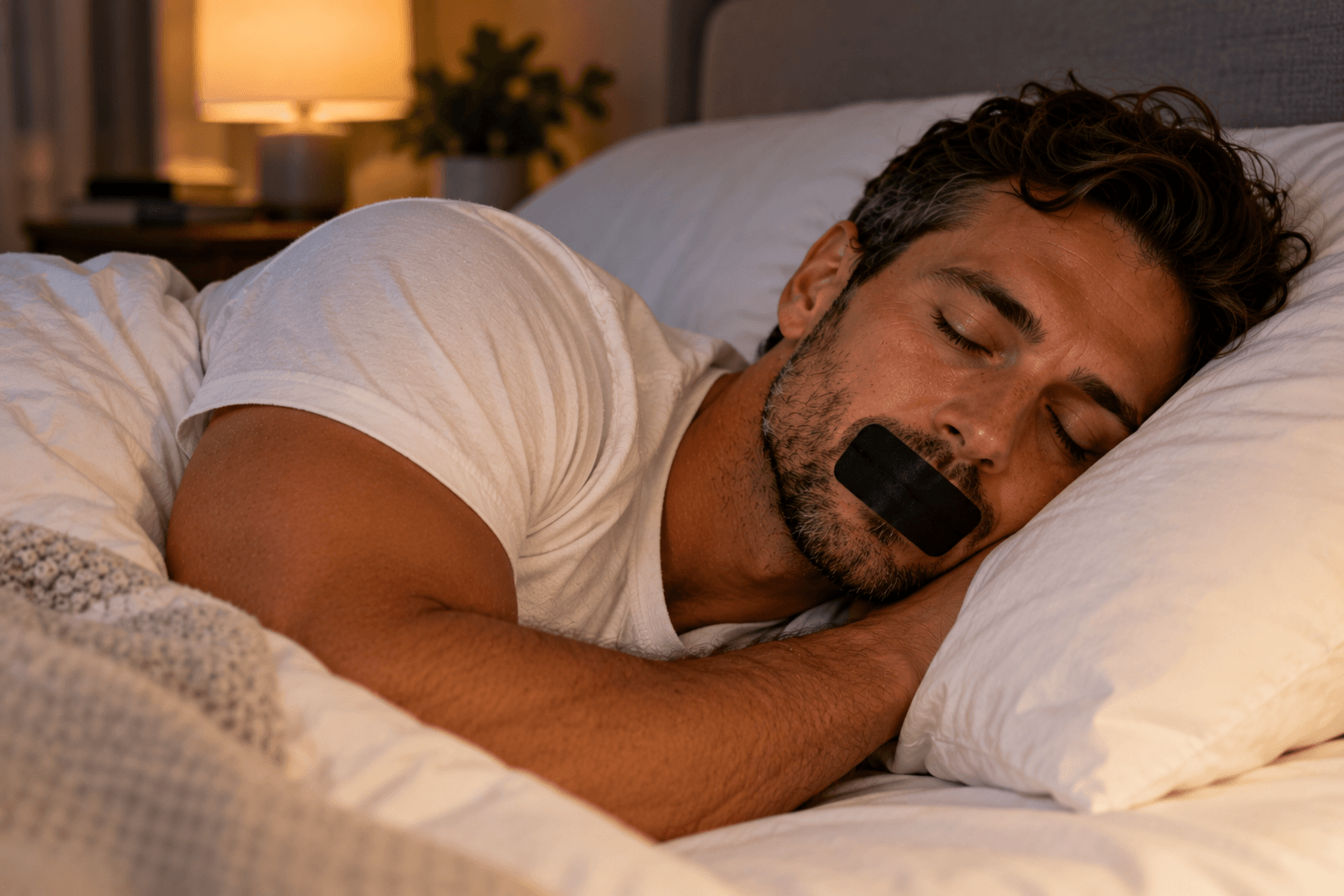
In short
- Our PubMed search found 21 records that mention mouth taping in the title or abstract, and 18 of them were published from 2022 onward.
- ClinicalTrials.gov lists 5 registered trials that mention mouth tape, and only 1, a Johns Hopkins study with an estimated March 2027 start, tests tape as its main intervention.
- Nasal dilators, including adhesive nasal strips, are Class I devices under 21 CFR 874.3900, while a search of Title 21 of the eCFR for "mouth tape" returned no results.
- We counted 27 FDA establishment listings with "mouth tape" in the product name, filed under 7 different Class I product codes; FDA says listing does not denote approval.
- A 2026 study of 390 Instagram reels tagged #mouthtape found 94.4% endorsed the practice, 55.4% were posted by companies and 11.6% by medical professionals.
- A 2025 PLOS One systematic review of 10 studies concluded the existing data does not support mouth taping as a sound clinical intervention for the general population with sleep-disordered breathing.
Mouth taping in 2026 is a popular habit with a small but growing research base. On October 20, 2026, we counted 21 PubMed records that mention it, 5 registered clinical trials, 27 FDA establishment listings with "mouth tape" in the product name and no federal regulation written for it. Most of the research activity dates from 2022 onward, and most of the social media content we found studied came from companies.
This report collects those numbers in one place, with the method behind each one, so anyone can check or reuse them. Our methodology section lists every query, and we've kept the raw counts on file. For a study-by-study summary of the trials themselves, see our mouth taping research tracker, which we keep separate from this report.
What are the key findings?
The key findings are that mouth taping research is recent and thin, regulation is light, and online content runs far ahead of the evidence. Here are the five numbers we'd point to first.
- Research is new: 18 of the 21 PubMed records that mention mouth taping were published from 2022 onward. Only 3 appeared before then, going back to 2006.
- Trials are few: ClinicalTrials.gov lists 5 registered trials that mention mouth tape, against 41 for nasal strips and nasal dilators. Only 1 of the 5 tests tape as the main intervention.
- Mouth tape has no rule of its own: nasal dilators have a Class I regulation, 21 CFR 874.3900. A search of Title 21 of the eCFR for "mouth tape" returns 0 results.
- Listings are scattered: the 27 FDA establishment listings we found with "mouth tape" in the product name sit under 7 different product codes, all Class I.
- Social media leans heavily positive: in a 2026 study of 390 Instagram reels, 94.4% endorsed mouth taping and 55.4% were posted by companies.
How much research on mouth taping is there?
Research: limited (what this means)There is very little research on mouth taping. Our PubMed search found 21 records that mention it in the title or abstract, and only 14 of them are mainly about mouth taping. For comparison, the same kind of search for nasal strips and nasal dilators found 226 records.
The table counts records by year. The first column for each topic assigns every record to its primary publication year, so nothing is counted twice. The second uses PubMed's own [dp] year filter, which can count a record in two years when its online and print dates fall in different years.
| Year | Mouth taping (de-duplicated) | Mouth taping ([dp] filter) | Nasal strips and dilators (de-duplicated) | Nasal strips and dilators ([dp] filter) |
|---|---|---|---|---|
| 2010 | 0 | 0 | 3 | 4 |
| 2011 | 0 | 0 | 6 | 6 |
| 2012 | 1 | 1 | 5 | 6 |
| 2013 | 0 | 0 | 7 | 7 |
| 2014 | 0 | 0 | 3 | 5 |
| 2015 | 0 | 0 | 7 | 7 |
| 2016 | 0 | 0 | 9 | 10 |
| 2017 | 0 | 0 | 5 | 5 |
| 2018 | 0 | 0 | 4 | 4 |
| 2019 | 0 | 0 | 10 | 11 |
| 2020 | 0 | 0 | 6 | 12 |
| 2021 | 0 | 0 | 8 | 8 |
| 2022 | 1 | 2 | 8 | 8 |
| 2023 | 3 | 3 | 3 | 4 |
| 2024 | 5 | 6 | 6 | 6 |
| 2025 | 6 | 6 | 4 | 6 |
| 2026 (to Oct 20) | 3 | 3 | 9 | 9 |
Two patterns stand out. Mouth taping went from almost no indexed papers to a handful every year starting in 2022. And in 2025, counting by primary publication year, PubMed added more records that mention mouth taping (6) than records that mention nasal strips or dilators (4). The nasal dilator literature is much older: it peaked between 1997 and 2001, with 56 records in those five years.
The mouth taping count is small enough that we read every title. Of the 14 records mainly about mouth taping, 13 were published from 2022 onward, and 4 are commentary rather than research: a letter, two comment pieces and an editorial. The other 7 records mention mouth taping in passing, for example as one part of a snoring program or a breathing exercise routine.
A note on "lip taping": we left it out of the main count on purpose. That search returned 32 records, and nearly all of them are about presurgical care for babies born with a cleft lip, which has nothing to do with sleep.
How many clinical trials on mouth taping are registered?
ClinicalTrials.gov lists 5 registered trials that mention mouth tape or mouth taping. Four are completed and one is recruiting. Only one of them, a Johns Hopkins study, is built around tape as the main intervention. In the others, tape is one part of a wider program or a similar device.
| Trial | Start | Status | Role of mouth tape | Results posted |
|---|---|---|---|---|
| NCT02738255, adhesive mouthpiece in sleep apnea | 2016 | Completed | Adhesive mouthpiece with a central opening, described as similar to mouth tape | Yes |
| NCT05404438, mouth breathing habits | 2018 | Completed | Tape worn during sleep tests and with oral appliances | No |
| NCT05756647, snoring treatments | 2022 | Completed | One part of a four-part conservative snoring program | Yes |
| NCT07353242, Buteyko breathing in asthma | 2024 | Completed | Used during breathing exercises | No |
| NCT06587256, silicone mouth tape for snoring | 2027 (estimated) | Recruiting | Main intervention | No |
For comparison, the same search approach for nasal strips and nasal dilators returned 41 registered trials. Some of those use a nasal strip as a placebo in sleep apnea studies, so the number reflects how often strips appear in research, not only trials of strips themselves.
We excluded one record that came up in a broader search. NCT06547658, the trial behind a 2024 JAMA Otolaryngology paper, closed participants' mouths by pressing on the chin during sleep endoscopy. No tape was used.
How is mouth tape regulated in 2026?
Mouth tape has no FDA regulation written for it, while nasal strips do. Under 21 CFR 874.3900, nasal dilators, including external strips with a spring material and skin adhesive, are Class I devices under general controls and exempt from premarket notification, subject to limits. A search of Title 21 of the eCFR for "mouth tape" or "mouth taping" returned no results on October 20, 2026.
Our guide to how mouth tape is regulated explains intended use, device classes and FDA's general wellness policy in more detail. What we added here is a count of how mouth tape actually shows up in FDA's records.
FDA's establishment registration and listing database, searched through the openFDA API, had 27 listing records with "mouth tape" in the proprietary name. Each record carried one product code, and the makers chose seven different ones.
| FDA product code | Device type | Regulation | Class | Listings with "mouth tape" in the name |
|---|---|---|---|---|
| KGX | Tape and bandage, adhesive | 21 CFR 880.5240 | I | 16 |
| LWF | Dilator, nasal | 21 CFR 874.3900 | I | 4 |
| OMW | Adhesive backed thermal skin patches | 21 CFR 890.5710 | I | 2 |
| FQM | Bandage, elastic | 21 CFR 880.5075 | I | 2 |
| PYO | Tape and bandage, adhesive, adjustable closing mechanism, OTC use | 21 CFR 880.5240 | I | 1 |
| FXP | Cover, shoe, operating-room | 21 CFR 878.4040 | I | 1 |
| FPX | Strip, adhesive, closure, skin | 21 CFR 880.5240 | I | 1 |
These listings are filed by the companies themselves, and FDA is clear about what they mean. It says mere registration of an establishment or listing of a device does not denote approval, and doesn't mean a product may be legally marketed. The spread of codes shows there's no settled category for mouth tape yet. It's also a reason to read "FDA registered" on a box as a filing, not an endorsement. Our piece on mouth tape marketing claims covers how to read those labels.
What do studies of mouth taping on social media show?
Two published studies have measured mouth taping content on social media, and both found it far more enthusiastic than the research. One looked at Instagram and one at TikTok. We searched PubMed for studies covering YouTube as well and found none on mouth taping.
| Study | Platform | Sample | Main numbers |
|---|---|---|---|
| Dentistry Journal, 2026 | 530 reels tagged #mouthtape collected in April 2025, 390 analyzed | 94.4% endorsed mouth taping; 55.4% posted by companies; 11.6% by medical professionals; supportive reels averaged 923 shares against 193 for critical ones | |
| American Journal of Otolaryngology, 2025 | TikTok | First 50 eligible videos found by searching "mouth taping" | Claimed benefits included better sleep quality (36% of videos), preventing cavities (24%), ending morning bad breath (22%), less dry mouth (18%), preventing snoring (16%) and improving or curing sleep apnea (6%) |
The TikTok percentages come from the scoping review as reported in a 2025 Journal of Dental Sleep Medicine editorial. The Instagram study also found that English-language posts drew more engagement, and that reels with male presenters got more likes and shares. Its authors concluded that the platform's content is driven largely by commercial accounts.
The gap matters most for the 6% of TikTok videos that tied mouth taping to sleep apnea. Mouth tape does not treat sleep apnea. Loud snoring with gasping or pauses in breathing is a reason to see a doctor. For the story of how the trend grew, see why mouth taping took off.
What do doctors and medical bodies say about mouth taping?
Most medical sources we could open are cautious about mouth taping, and none we found endorses it for sleep disorders. Their reasons are the small evidence base and the risk for people who can't breathe well through the nose. Some reviews also point to possible benefits, mainly for snoring in people who breathe through their mouths, and call for more research.
| Source | Year | Position, in brief |
|---|---|---|
| Cleveland Clinic (pediatric sleep medicine specialist) | 2025 | Not recommended; "not part of our current practice to treat any sleep disorder." Never use with nasal obstruction, congestion, chronic allergies, sinus infections, enlarged tonsils, a deviated septum or heart issues. Suggests side sleeping and nasal strips for snoring |
| PLOS One systematic review (10 studies, 213 patients) | 2025 | Existing data does not support mouth taping as a sound clinical intervention for the general population with sleep-disordered breathing; possible serious risk of harm for people taping indiscriminately |
| American Journal of Otolaryngology scoping review | 2025 | Evidence is mixed with little consensus; some research suggests possible benefits, including for snoring; more high-quality research needed |
| Journal of Dental Sleep Medicine editorial | 2025 | Limited evidence in favor for mild sleep apnea or snoring, no evidence for most other claims; points patients to oral appliances and ENT referral for nasal obstruction |
| JAMA Otolaryngology trial (54 patients analyzed) | 2024 | Closing the mouth by hand improved airflow overall but worsened it in heavy mouth breathers, and a blockage at the back of the nasal airway was linked to worse airflow with the mouth closed; authors call for personalized approaches |
| American Academy of Sleep Medicine | n/a | No formal position statement found that we could open |
On the AASM: its main website blocked our automated request, and a search of its patient site, sleepeducation.org, returned no page on mouth taping. AASM's own journal, the Journal of Clinical Sleep Medicine, did publish a 2025 randomized crossover trial in which 62 people with mouth breathing and sleep apnea used silicone mouth tape alongside CPAP for 30 days. They used CPAP for about 52 minutes more per day with tape. That was tape added to prescribed CPAP under medical care, not tape in place of it. More on that in mouth tape and CPAP.
The advice these sources share is to check your nose first and rule out sleep apnea. We cover the concerns doctors raise in why some doctors warn against mouth tape, and the safety checks in is mouth taping safe?. We don't recommend mouth tape for children.
Check this first. Skip mouth tape and see a doctor if you snore loudly, wake up gasping, have been told you stop breathing in your sleep, or can't breathe comfortably through your nose. More on safety
What should we watch for in 2027?
The most concrete thing to watch in 2027 is whether the Johns Hopkins mouth tape trial starts enrolling. Everything below is based on dates in public records, not predictions about results.
| What | Source | What the record says |
|---|---|---|
| Johns Hopkins silicone mouth tape trial (MTASSA) | NCT06587256 | Estimated start March 1, 2027; target of 100 participants; estimated primary completion October 2030. Results are not expected in 2027 |
| Buteyko breathing trial in asthma | NCT07353242 | Completed July 2025, registered January 2026, no results posted yet |
| Rest of 2026 in PubMed | Our search | 3 records so far in 2026 by primary year; the full-year count won't be settled until indexing catches up |
| FDA listings | openFDA | 4 of the 27 "mouth tape" listing records were created in 2026 |
One detail in the Johns Hopkins record is worth noting. It lists the trial as recruiting, while its start date is an estimate in 2027. The record was last updated in June 2026, so the dates could change. If it runs as planned, it will be the first registered trial built around mouth tape for snoring, and its primary outcome is a snoring and sleep survey.
How we collected the data
All searches were run on October 20, 2026, with automated requests that contained only search terms.
- PubMed: NCBI E-utilities esearch and esummary. Mouth taping query: ("mouth taping"[tiab] OR "mouth tape"[tiab] OR "mouth-taping"[tiab] OR "mouth taped"[tiab] OR "taping the mouth"[tiab] OR "oral taping"[tiab] OR "mouth taping"[tw]). Nasal query: ("nasal strip"[tiab] OR "nasal strips"[tiab] OR "nasal dilator"[tiab] OR "nasal dilators"[tiab] OR "external nasal dilator"[tiab] OR "nasal dilator strip"[tiab]). Yearly counts used "AND YYYY[dp]"; de-duplicated counts used each record's primary publication date.
- ClinicalTrials.gov: API v2 full-text search for "mouth taping", "mouth tape" and "mouth-taping", then each record read in full. Nasal comparison: "nasal strip" OR "nasal strips" OR "nasal dilator" OR "nasal dilators".
- FDA: eCFR search API for Title 21; openFDA device classification (regulation 874.3900); openFDA registration and listing, proprietary_name:"mouth tape" (dataset last updated October 5, 2026).
- Social media and professional positions: PubMed search for mouth taping with TikTok, Instagram, YouTube, social media or reels, plus the professional sources linked above.
Limits apply. Title and abstract searches miss papers that use other words, such as "mouth closing" or "porous oral patch", and our nasal query picks up some off-topic records, including horse studies and nasal swab strips. Counts for 2026 are partial. FDA listing names are written by companies, so the 27 records are a floor, not a market count. We saved the raw numbers, PubMed IDs and trial details in a data file alongside this report, so the counts can be checked or re-run.
How to cite this report
You're welcome to use these numbers with a link back. Suggested citation:
Better Mouth Tapes editorial team. "The state of mouth taping in 2026: research, regulation and the social media boom." Better Mouth Tapes, October 20, 2026. https://www.bettermouthtapes.com/blog/state-of-mouth-taping-2026
If you're comparing with nasal strips, our nasal strip research roundup summarizes that older body of work.
Read next
- Mouth taping research tracker
- Is mouth tape regulated? How the FDA treats tapes, strips and sleep products
- Why mouth taping took off: 7 things that drove the trend
Common questions
How many studies have been published on mouth taping?
Very few. On October 20, 2026, our PubMed search found 21 records that mention mouth taping in the title or abstract. Only 14 are mainly about mouth taping, and 4 of those are comments, letters or editorials. Most of the activity is recent: 18 of the 21 records were published from 2022 onward.
Are there clinical trials on mouth taping?
A few. ClinicalTrials.gov lists 5 registered trials that mention mouth tape. Four are completed, and in three of those, tape was one part of a wider program. The only trial built around tape itself is a Johns Hopkins study of silicone mouth tape for snoring, with an estimated start of March 2027.
Is mouth tape regulated by the FDA?
There's no FDA classification regulation written for mouth tape, and a search of Title 21 of the eCFR for the phrase returns nothing. Products are listed with FDA under other device types, most often medical adhesive tape. Nasal strips are different: they have their own Class I regulation, 21 CFR 874.3900.
Why is mouth taping so popular on social media?
Companies post much of the content, and supportive posts travel further. A 2026 study of 390 Instagram reels tagged #mouthtape found 94.4% endorsed the practice and 55.4% came from companies. Supportive reels averaged 923 shares, against 193 for critical ones.
What does the American Academy of Sleep Medicine say about mouth taping?
We couldn't find a formal AASM position statement on mouth taping that we were able to open. AASM's journal, the Journal of Clinical Sleep Medicine, did publish a 2025 randomized crossover trial of silicone mouth tape used alongside CPAP in 62 people with mouth breathing and sleep apnea.
Do doctors recommend mouth taping?
Most medical sources we checked are cautious. A Cleveland Clinic sleep specialist says it isn't part of their current practice for any sleep disorder and lists conditions where it should never be used, such as a blocked nose. A 2025 dental sleep medicine editorial acknowledges limited evidence for mild snoring and calls for more research.
Sources
- The spread of non-evidence-based health claims on social media: the case of #Mouthtape on Instagram, a cross-sectional study
- Nocturnal mouth-taping and social media: a scoping review of the evidence
- Navigating the social media wave: mouth taping and the role of sleep dentistry
- Breaking social media fads and uncovering the safety and efficacy of mouth taping in patients with mouth breathing, sleep disordered breathing, or obstructive sleep apnea: a systematic review
- Is mouth tape safe to use while sleeping?
- The role of mouth tape for CPAP use in patients with mouth breathing and OSA
- Mouth closure and airflow in patients with obstructive sleep apnea: a nonrandomized clinical trial
- Mouth Tape for Snoring and Sleep Apnea (MTASSA), NCT06587256
- 21 CFR 874.3900: Nasal dilator
- Is it really 'FDA approved'?
About this article
- Research
- 10 published sources, listed above.
- Evidence
- Limited. How we rate it
- Last checked
- October 20, 2026
- Funding
- Paid partner of Titan Recovery. Their ads are labeled.
- Found an error?
- Tell us. We log fixes on the corrections page.
* This content is for informational and educational purposes only and is not medical advice. It is not intended to diagnose, treat, cure or prevent any disease or health condition. Talk to a qualified healthcare provider about your health.