In short
- The EPA says humidifiers are commonly used to relieve a dry nose, throat, lips and skin, and Cleveland Clinic cites the EPA's range of 30% to 50% humidity at home.
- Clean a portable humidifier every third day and refill it daily with low-mineral water, the EPA says, and don't push humidity above 50%.
- Cleveland Clinic says humidity below 30% can leave you vulnerable to nosebleeds, and suggests saline spray and some ointment before bed.
- Your nose warms and humidifies the air you breathe, so keeping your mouth closed at night matters more when the air is dry.
- Nasal strips help a narrow nose, and mouth tape keeps your lips closed when your nose is clear. Never tape with a blocked nose.
When the air is dry, the best things you can do for nighttime breathing are to put moisture back into the bedroom, keep the inside of your nose from drying out, and keep breathing through your nose so it can warm and moisten each breath for you. A clean humidifier set between 30% and 50%, saline before bed and a nasal strip or mouth tape cover most of it.
Dry air isn't just uncomfortable. "When the air is dry, your respiratory system just isn't happy," Cleveland Clinic pulmonologist Sobia Farooq, MD, says. Here are nine tips, starting with the room.
Fix the air
Run a humidifier in the bedroom
The EPA says humidifiers are commonly used to relieve a dry nose, throat, lips and skin, and that the added moisture also eases nuisances of winter heating like static electricity. Cleveland Clinic adds that when your airways are dried out, you're more likely to snore and to wake up coughing, with a nosebleed or with a dry mouth. Keeping your upper airways properly moisturized helps them work more smoothly, and a humidifier also helps thin mucus, it says, so blowing your nose works better. How long to run it depends on the unit. Cleveland Clinic says some need as little as two hours, while others work best running for 10 or 12 hours, so check the instructions. Does a humidifier help you breathe better at night? looks at the research.
Aim for 30% to 50% humidity, and measure it
Cleveland Clinic cites the EPA's recommendation of 30% to 50% humidity at home, and says to run a humidifier whenever yours falls below that. Don't overshoot. The EPA says not to go above 50%, because higher humidity can encourage dust mites and mold, and to turn the humidifier down if water condenses on windows or walls. A hygrometer from a hardware store takes out the guesswork, and Cleveland Clinic suggests checking your levels every few days.
Keep the humidifier clean
The EPA recommends emptying, drying and refilling a portable humidifier daily, and cleaning it every third day to remove scale and film. It also suggests water with low mineral content, such as distilled water, because ultrasonic and cool mist models can spray minerals and microorganisms from their tanks into the air. Evaporative and steam models generally disperse less, it says, but steam vaporizers should be kept out of children's reach because hot water and steam can burn. Cleveland Clinic adds that most humidifiers aren't designed for essential oils or vapor rubs, so keep those out of the tank unless the maker says otherwise. Stop using it and talk to a doctor if you notice breathing symptoms that seem to come with it, the EPA says.
Keep the bedroom cool, not hot
A cool bedroom is better for sleep, even though it can be tempting to crank the heat in winter. The Sleep Foundation says the best bedroom temperature for sleep is around 65 F, with most doctors recommending 65 to 68 F. Your body temperature naturally drops as you sleep, it explains, so a cooler room makes it easier to fall and stay asleep. A room that's too warm can cause restlessness, it says, and a very cold room isn't ideal either. Add a blanket rather than turning the heat up.
Look after your nose and mouth
Use saline spray and a little ointment before bed
Cleveland Clinic ear, nose and throat specialist Swathi Appachi, MD, explains that the blood vessels in the septum are very sensitive to dryness and can crack and bleed when the lining dries out, especially when humidity drops below 30%. Her advice for nighttime dryness is saline spray, then some ointment before going to bed. Drug-free saline also softens dried mucus so it clears with a gentle blow, and Dr. Appachi notes that forceful nose blowing can itself injure the septum and cause bleeding. If you do get a nosebleed, her advice is to lean forward and pinch the nostrils for at least five minutes without letting go, since many people release too soon. Dry nose at night and nosebleeds at night cover more.
Go easy on decongestant sprays
Winter colds make decongestant sprays tempting, and they do give short-term relief. But Cleveland Clinic says using them longer than the package says, usually three days, can cause rebound congestion that's worse than where you started. Saline sprays don't carry that risk. Decongestant spray rebound explains how to get off them if you're stuck.
Keep water by the bed
The NHS suggests drinking plenty of water during the day and keeping some by your bed at night for a dry mouth. The NIDCR puts plenty of water at 8 to 12 cups a day for people dealing with dry mouth, and adds that cutting back on caffeine helps, since it can dry out your mouth, and that sugarless gum can help get saliva flowing.
Keep breathing through your nose
Wear a nasal strip if your nose feels tight
Your nose does the most work conditioning air in dry weather. A 2000 study of 23 volunteers found the biggest rise in humidity and temperature of inhaled air happened in the front of the nose. Lying down raises nasal resistance a little, a 2022 meta-analysis found, so a nose that feels fine by day can feel narrow in bed. A nasal strip gently lifts the sides of the nose open from the outside. Cleveland Clinic ear, nose and throat specialist Michael Benninger, MD, names nasal strips, along with a steroid nasal spray, as longer-term options when congestion is pushing you into mouth breathing and a sore morning throat. A 2016 meta-analysis noted that nasal dilators have been shown to improve nasal breathing, though they didn't change sleep apnea measures.
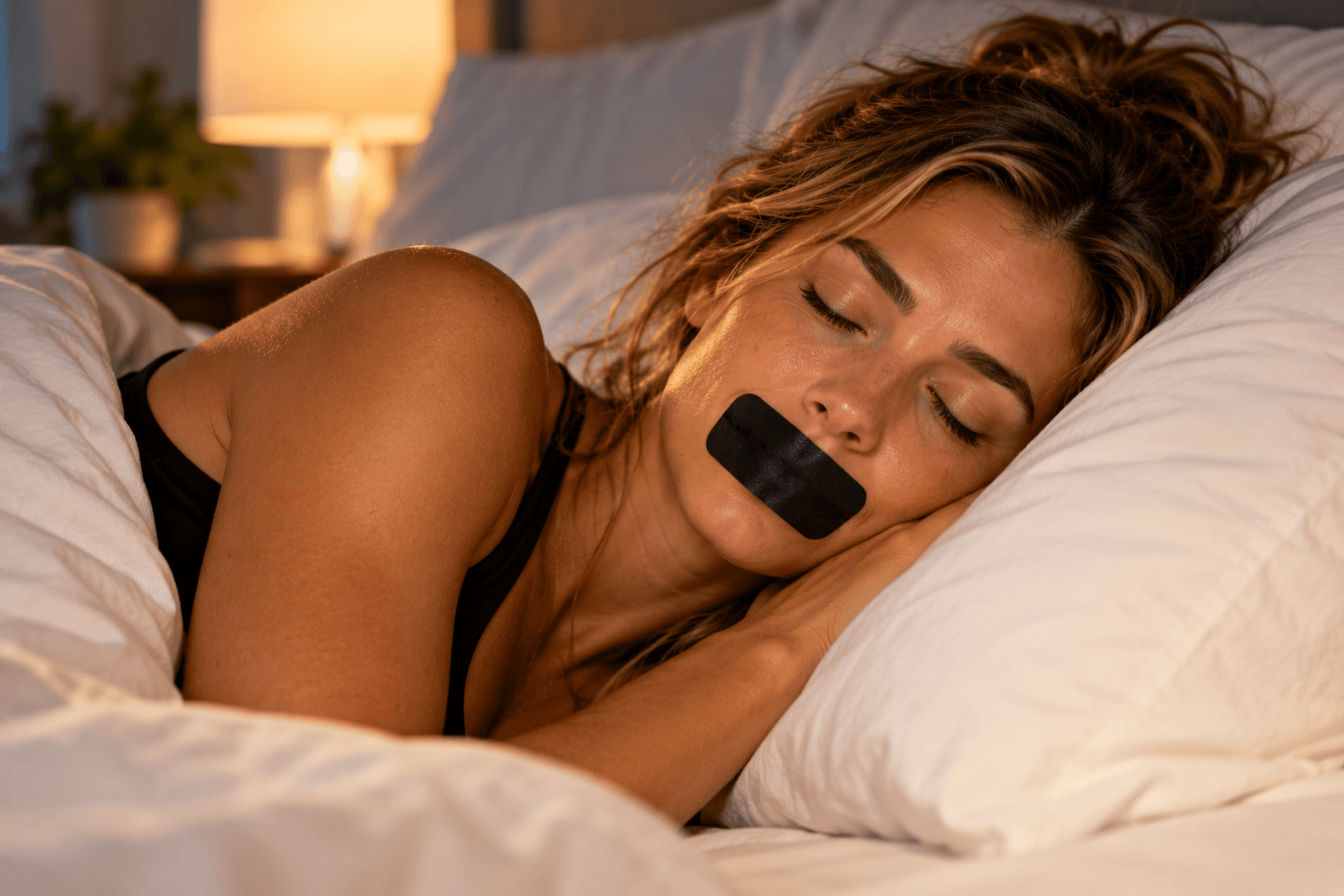
Keep your lips closed with mouth tape
If your mouth falls open, air skips the nose and dries out your mouth and throat. Cleveland Clinic says breathing through your nose helps keep moisture in your mouth and throat, and the NHS lists mouth breathing at night as one of the main causes of dry mouth. Mouth tape is a simple way to keep your lips together so air takes the warmer, moister route. The Sleep Foundation describes it as a gentle reminder that promotes nasal breathing, and suggests testing it during the day first and using a porous tape made for skin. Research on tape is still limited, and a 2025 review warned of serious risk for anyone who tapes with a blocked nose, so leave it off during a cold. See a doctor before trying it if you snore loudly with choking, gasping or heavy daytime tiredness, which the Sleep Foundation lists as signs of sleep apnea. Tape and strips are for adults only. Our first-week guide helps you start.
Research: moderate (what this means)Check this first. Skip mouth tape and see a doctor if you snore loudly, wake up gasping, have been told you stop breathing in your sleep, or can't breathe comfortably through your nose. More on safety
Our pick: the Titan Sleep System (paid partner)
For dry nights, the set we recommend is the Titan Sleep System, which pairs TitanAir Nasal Strips with Titan Bamboo Silk Mouth Tape. Titan describes the bamboo silk tape as soft, breathable and moisture-wicking, with an adhesive made to grip through stubble and beards, and says the strips are drug-free with flexible spring-loaded bands worn just above the flare of the nostrils. Titan suggests 20 to 30 minutes of daytime practice with the tape before your first night, says every batch is third-party tested and certified PFAS-free, and offers a 30-night guarantee.
For more, browse our nasal breathing articles.
Read next
- 8 benefits of breathing through your nose
- Why do I wake up with a dry mouth?
- 11 ways to breathe through your nose at night
Common questions
What humidity is best for sleeping in winter?
Between 30% and 50%. Cleveland Clinic cites the EPA's recommendation for that range, and the EPA says not to go above 50%, since higher humidity can encourage mold and dust mites.
Why is it harder to breathe at night in winter?
Cleveland Clinic says humidity below 30% is more common when the heat is running, and that dried-out airways make snoring and waking with a dry mouth more likely. Lying down also raises nasal resistance a little, a 2022 meta-analysis found, so a nose that feels tight by day can feel worse in bed.
Does a humidifier help with snoring?
It may help some people. Cleveland Clinic says you're more likely to snore when your airways are dried out. Snoring has many causes, so it won't fix everyone's.
How do I stop my nose from drying out at night?
Run a humidifier to keep the room between 30% and 50%, and use saline spray before bed. Cleveland Clinic's ear, nose and throat specialist suggests saline spray followed by some ointment for nighttime dryness.
Is it safe to use mouth tape in winter?
It's a reasonable option for adults with a clear nose, and keeping your mouth closed means air goes through your nose, where it gets warmed and moistened. Skip it if a cold or congestion blocks your nose, and see a doctor first if you might have sleep apnea.
When should I see a doctor about nosebleeds or dryness?
Cleveland Clinic says most nosebleeds stop after 10 to 15 minutes of gentle pressure, and that some call for medical attention, so get help if bleeding won't stop. See a doctor too if congestion lasts despite home care.
How do I fix dry mouth at night in winter?
Put moisture back into the air and keep your mouth closed. Run a clean humidifier to keep the bedroom between 30% and 50% humidity, keep water by the bed as the NHS suggests, and if your nose is clear, use mouth tape so air goes through your nose. Cleveland Clinic says you're more likely to wake with a dry mouth when your airways are dried out.
How do you fix mouth breathing at night?
Work on your nose first, then your lips. A nasal strip gently lifts the sides of the nose open if it feels tight, and a 2016 meta-analysis found nasal dilators improve nasal breathing. If your nose is clear and your mouth still falls open, mouth tape keeps your lips together, but leave it off during a cold.
Sources
- Use and care of home humidifiers
- 4 reasons to run a humidifier
- Why you're getting nosebleeds at night
- Best temperature for sleep
- Rhinitis medicamentosa
- Dry mouth
- Dry mouth
- Humidity and temperature profile in the nasal cavity
- Why you have a sore throat in the morning
- The Recumbent Position Affects Nasal Resistance: A Systematic Review and Meta-Analysis
- Nasal Dilators (Breathe Right Strips and NoZovent) for Snoring and OSA: A Systematic Review and Meta-Analysis
- Mouth taping for sleep: does it work?
- Breaking social media fads and uncovering the safety and efficacy of mouth taping in patients with mouth breathing, sleep disordered breathing, or obstructive sleep apnea: A systematic review
- Titan Sleep System (Nasal Strips + Mouth Tape)
About this article
- Research
- 14 published sources, listed above.
- Evidence
- Moderate. How we rate it
- Last checked
- October 10, 2026
- Funding
- Paid partner of Titan Recovery. Their ads are labeled.
- Found an error?
- Tell us. We log fixes on the corrections page.
* This content is for informational and educational purposes only and is not medical advice. It is not intended to diagnose, treat, cure or prevent any disease or health condition. Talk to a qualified healthcare provider about your health.