In short
- A 2019 meta-analysis in Sleep Medicine Reviews found that a warm shower or bath at 40 to 42.5 C was linked to better self-rated sleep quality and sleep efficiency.
- In the same review, warm water 1 to 2 hours before bedtime, for as little as 10 minutes, was linked to falling asleep significantly faster.
- In a small crossover trial of 11 youth soccer players, a 10-minute shower at about 40 C just before lights out cut the time to fall asleep by about 7 minutes on average.
- A 2023 study of 23 adults found that a long soak in a bathtub shortened the time to fall asleep compared with showering only.
- The NHS suggests sitting in the bathroom with a hot shower running to ease a blocked nose, and a Cochrane review rated the evidence for heated, humidified air for colds as low quality.
- 3M's guidance on medical tape says tape should be applied to clean, dry skin, and Titan says to apply its nasal strips to clean, dry skin and skip moisturizer.
Showering before bed is a good idea for most people, as long as the water is warm and the timing is right. The research points to a warm shower or bath about 1 to 2 hours before bed as the sweet spot for falling asleep faster. A steamy bathroom can also ease a stuffy nose for a while, and a clean, dry face sets you up for a nasal strip or mouth tape afterwards.
Does a warm shower before bed help you sleep?
Research: moderate (what this means)A warm shower before bed does seem to help you sleep. The best summary of the research is a 2019 systematic review and meta-analysis in Sleep Medicine Reviews from the University of Texas at Austin. The authors screened more than 5,000 articles and found 17 that met their criteria, and 13 had data they could pool.
Water at 40 to 42.5 C (about 104 to 109 F) was linked to better self-rated sleep quality and better sleep efficiency, which is the share of time in bed actually spent asleep. When the shower or bath was taken 1 to 2 hours before bedtime, it also shortened the time it took to fall asleep, even when people spent as little as 10 minutes in the water.
The authors were open about the limits. They said there's still relatively little research, especially on the best timing and length. So a warm shower isn't a fix for insomnia, but it's a cheap, pleasant habit with real evidence behind it. The National Heart, Lung, and Blood Institute lists a hot bath or relaxation techniques before bed among its healthy sleep habits. Our guide to how to fall asleep faster covers the other habits with good support.
Why does warm water make you sleepy?
Warm water makes you sleepy mainly because of what happens after you get out. The 2019 review explains that warm water sends more blood to the palms and soles. That helps the body release heat through the hands and feet, so your core temperature drops more by bedtime. The authors think the size of that drop is what drives the effect.
It sounds backwards to heat up in order to cool down, but the timing explains it. You warm up in the shower, then spend the next hour or so shedding that heat. Our guide to the best bedroom temperature for sleep explains why a cool room helps the same process along.
What's the best time to shower before bed?
The best time to shower before bed is about 1 to 2 hours before you plan to sleep. That's the window the 2019 meta-analysis linked to falling asleep faster, and it gives your body time to cool down afterwards.
Later can still work. In a small 2017 crossover trial, 11 youth soccer players spent three days taking a 10-minute shower at about 40 C right before lights out and three days sleeping as normal. On shower nights, they fell asleep about 7 minutes faster on average and their sleep efficiency was 2% higher. That's a small group of young athletes, so it's a useful hint rather than a rule.
| Option | Timing in the research | What was found |
|---|---|---|
| Warm shower or bath, 40 to 42.5 C | 1 to 2 hours before bed, from 10 minutes | Faster sleep onset, better sleep quality and efficiency (2019 meta-analysis) |
| Warm shower, about 40 C, 10 minutes | Just before lights out | About 7 minutes faster to fall asleep in 11 athletes (2017 trial) |
| Long bath vs shower only | 1.5 to 2 hours before bed | Long bath led to faster sleep onset than showering (2023 study, 23 adults) |
| Hot shower with the door closed | Any time a blocked nose bothers you | NHS suggests it to ease a blocked nose; evidence for heated air is low quality |
Is a bath better than a shower?
A bath may be a little better than a shower if you have the time. A 2023 study in the Journal of Physiological Anthropology had 23 healthy adults in their 20s to 50s bathe at home 1.5 to 2 hours before bed in three ways: a shower only, a short bath and a long bath. The long bath raised body temperature the most, and its later fall before sleep was larger. People fell asleep faster after the long bath than after a shower, and rated falling asleep and sleep quality better.
The authors suggested that a bath that raises body temperature by about 0.9 C works better than one that raises it by about 0.3 C. In everyday terms, a proper soak does more than a quick rinse. Still, the shower studies show benefits too, and the habit you'll actually keep is the one that matters most.
Can steam from a shower help a stuffy nose?
Steam from a shower can make a stuffy nose feel better for a while. The NHS suggests breathing in steam to ease a blocked nose, and recommends sitting in the bathroom with a hot shower running. It also says not to let children breathe steam from a bowl of hot water because of the risk of scalding.
The research on steam itself is thin. A 2017 Cochrane review of six trials with 387 people found it uncertain whether heated, humidified air relieves cold symptoms, and found no evidence of benefit or harm. So a steamy shower is a comfort measure. It feels good, it's safe when there's no hot bowl to tip over, and it fits neatly into a bedtime routine. Our full guide to steam for a stuffy nose covers the burn risks and safer options.
If your nose still feels tight after the steam wears off, a nasal strip works in a different way. It doesn't add moisture. It lifts the sides of the nose to widen the passage just inside the nostrils. In a study of 89 people with nasal blockage, a strip gave a gain in nasal airflow, and in how blocked people felt, that was comparable to a decongestant spray, though it had no effect deeper inside the nose. Many people like to shower, dry off, and put on TitanAir Nasal Strips as the last step before bed. There's more in how to unblock your nose before bed.
How should you prep your skin for strips or mouth tape after a shower?
Prep your skin for strips or tape by making sure it's clean and completely dry. 3M's guidance on medical tape says tape should be applied without tension to clean, dry skin. Damp skin from a steamy bathroom is one of the easiest ways to lose a strip by midnight.
A few small habits help:
- Towel your face dry, then give it a few minutes out of the steam before you apply anything.
- Skip moisturizer, face oil and lip balm where the strip or tape will sit. Titan says its strips go on clean, dry skin and to skip moisturizer.
- Press the strip or tape on gently and don't stretch it. 3M says stretching tape as you apply it is a common cause of tension injuries to the skin.
- In the morning, Titan suggests loosening its strips with warm water and peeling slowly from the ends inward, which is easy to do in the shower.
Our guides to how to apply nasal strips and why a nasal strip falls off at night go into placement and hold. If you use mouth tape, the same clean, dry rule applies to your lips and the skin around them, so save balms and creams for the morning.
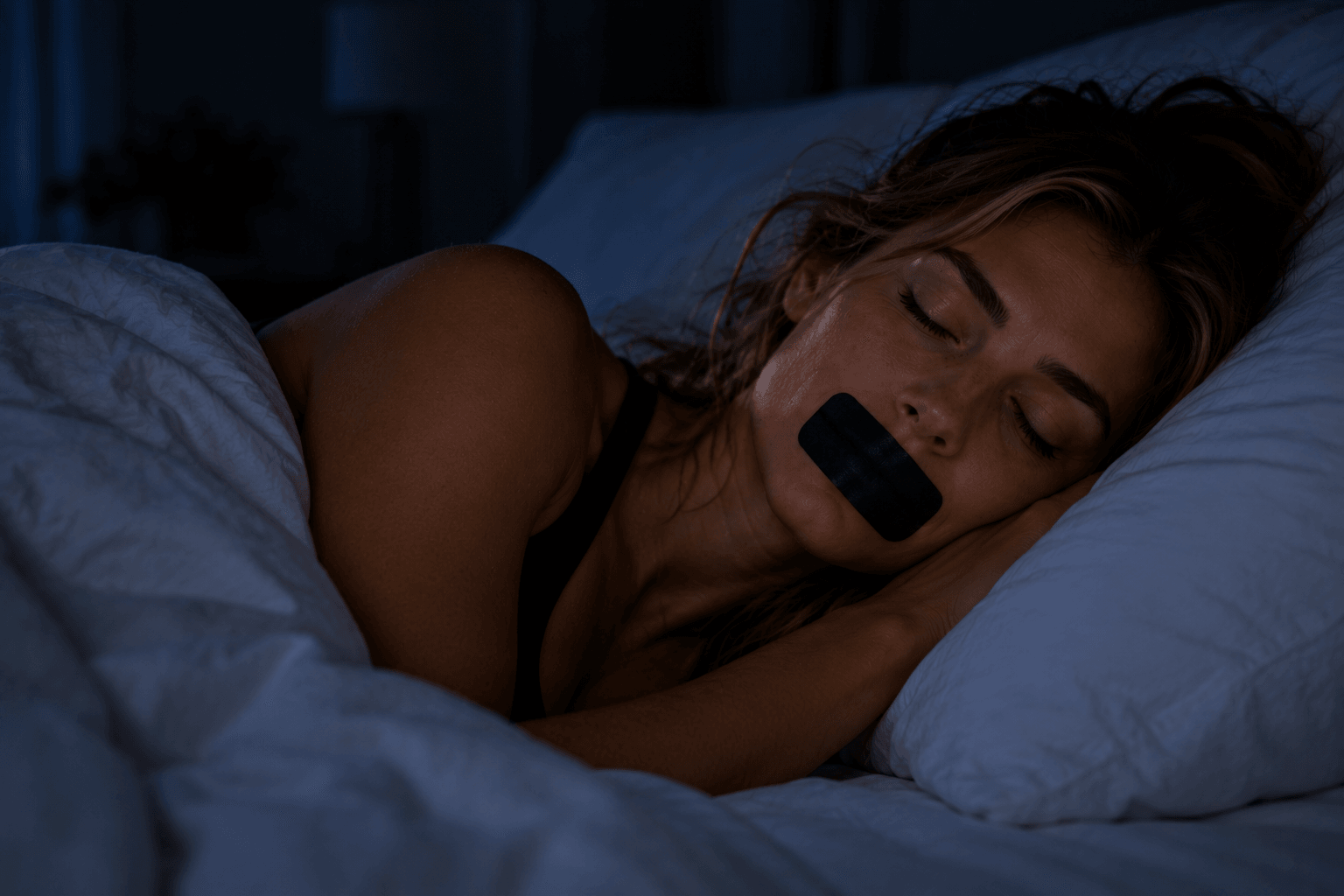
Mouth tape is only for adults who can breathe easily through the nose with the mouth closed, so skip it on nights when a cold has you blocked up. We don't recommend mouth tape for children.
Check this first. Skip mouth tape and see a doctor if you snore loudly, wake up gasping, have been told you stop breathing in your sleep, or can't breathe comfortably through your nose. More on safety
What's a simple shower-to-bed routine?
A simple routine starts with a warm shower or bath about an hour or two before bed, then a cool, dark bedroom. Here's one way to put it together:
- Take a warm shower or bath, around 40 C if you can gauge it, for at least 10 minutes. If your nose is blocked, close the door and let the room steam up.
- Dry off fully and get into light, comfortable clothes.
- Spend the next hour winding down somewhere dim. The NHLBI suggests avoiding bright artificial light from a TV or computer screen in the hour before bed.
- Just before bed, put on a nasal strip such as TitanAir Nasal Strips if your nose feels tight, and mouth tape if you use it.
Our bedtime routine for better breathing builds out the rest of the evening.
When should you see a doctor?
You should see a doctor if poor sleep or a blocked nose keeps going despite good habits. The NHS advises seeing a GP if cold symptoms don't improve after 10 days, get worse, or come with a high temperature for more than 3 days, shortness of breath or chest pain. A nose that's blocked most nights without a cold is also worth getting checked.
Snoring is a separate question. The NHS lists breathing that stops and starts during sleep, gasping, snorting or choking noises, and feeling very tired during the day as symptoms of sleep apnoea, and says to see a GP if you have them. Nasal strips and mouth tape don't treat sleep apnea. If you're pregnant, ask your midwife or doctor before trying strips or tape.
Our pick (paid partner): TitanAir Nasal Strips
For a stuffy nose after your evening shower, our pick is TitanAir Nasal Strips. This is our recommendation, not something we've tested or ranked ourselves, and no published study has looked at this particular strip.
Titan says they are drug-free external nasal dilators with flexible, spring-loaded bands. Its directions fit a post-shower routine well: start with clean, dry skin and no moisturizer, then place the strip just above the flare of the nostrils, on the soft part of the nose rather than the bony bridge. For removal, Titan says to loosen the strip with warm water and peel slowly from the ends inward. Titan says the strips are third-party tested and certified PFAS-free, are designed to pair with its mouth tape, and come with a 30-night guarantee.
Read next
Common questions
Is it good to shower before bed?
For many people, yes. A 2019 meta-analysis found that a warm shower or bath at 40 to 42.5 C was linked to better sleep quality and sleep efficiency, and that one taken 1 to 2 hours before bed helped people fall asleep faster. The studies were fairly small, so treat it as a helpful habit rather than a cure for poor sleep.
How long before bed should you shower?
About 1 to 2 hours before bed is the window with the most support. That's when the 2019 meta-analysis found warm water shortened the time to fall asleep, even with just 10 minutes in the water. A small trial in athletes also found a benefit from a 10-minute warm shower right before lights out, so later still works for some people.
Is a bath better than a shower for sleep?
A longer, deeper soak may have the edge. In a 2023 Japanese study of 23 adults, a long bath 1.5 to 2 hours before bed raised body temperature more than a shower, and people fell asleep faster and rated their sleep better. A shower still counts, and it's the easier habit to keep on busy nights.
Does a hot shower help a stuffy nose at night?
It can make a blocked nose feel better for a while. The NHS suggests sitting in the bathroom with a hot shower running. Research on heated, humidified air is weak, and a Cochrane review called the evidence for colds low quality. A steamy shower is still a safer way to try it than leaning over a bowl of hot water.
Should I put a nasal strip on right after a shower?
Wait until your nose is completely dry. 3M's guidance on medical tape says tape should go on clean, dry skin, and Titan says its strips go on clean, dry skin with no moisturizer. Steam and damp skin can stop the adhesive from gripping, so give your face a few minutes after you towel off.
Can a cold shower before bed help you sleep?
The research on showers and sleep mostly tested warm water, not cold. The 2019 meta-analysis focused on water at 40 to 42.5 C, and the authors think it works because warm water helps the body shed heat afterwards. There isn't comparable evidence that a cold shower before bed helps you fall asleep.
Sources
- Before-bedtime passive body heating by warm shower or bath to improve sleep: A systematic review and meta-analysis
- A shower before bedtime may improve the sleep onset latency of youth soccer players
- Effects of bathing-induced changes in body temperature on sleep
- Heated, humidified air for the common cold
- Common cold
- Healthy sleep habits
- Medical Adhesive Related Skin Injuries (MARSI)
- Effects of an external nasal dilator strip (ENDS) compared to xylometazolin nasal spray
- Sleep apnoea
- TitanAir Nasal Strips
About this article
- Research
- 10 published sources, listed above.
- Evidence
- Moderate. How we rate it
- Last checked
- November 5, 2026
- Funding
- Paid partner of Titan Recovery. Their ads are labeled.
- Found an error?
- Tell us. We log fixes on the corrections page.
* This content is for informational and educational purposes only and is not medical advice. It is not intended to diagnose, treat, cure or prevent any disease or health condition. Talk to a qualified healthcare provider about your health.