In short
- No published study has tested mouth tape during exercise. The research on exercise looks at people choosing to breathe through the nose, who can open their mouth whenever they need to.
- In a 1980 study of 30 healthy adults, most switched from nose to nose-and-mouth breathing at a breathing rate of about 35 litres a minute during moderate exercise.
- In a 1995 study of 20 active adults, nose-only breathing lowered maximal ventilation and maximal oxygen uptake, though everyone could still work hard enough for an aerobic training effect.
- A 2022 review of breathing strategies for runners suggests nasal breathing suits low-intensity exercise and lists 'difficult at high intensities' as its main drawback.
- A 2025 systematic review notes that keeping the mouth closed with tape, a seal or a chin strap could pose a serious risk of asphyxiation if the nose is blocked.
- Nasal strips delayed the switch to mouth breathing during exercise in a small 1999 study, and they leave your mouth free, which makes them a safer training aid than tape.
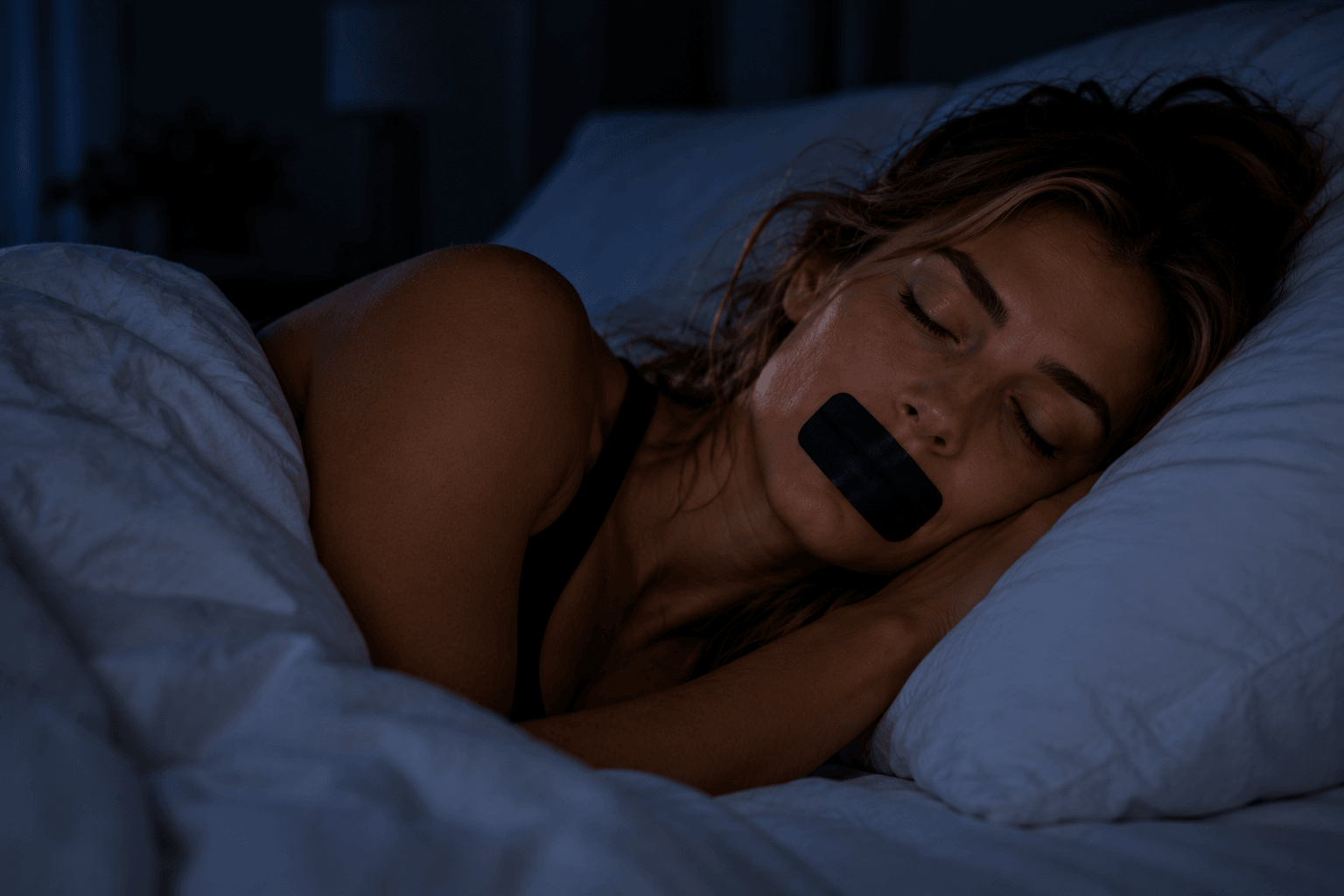
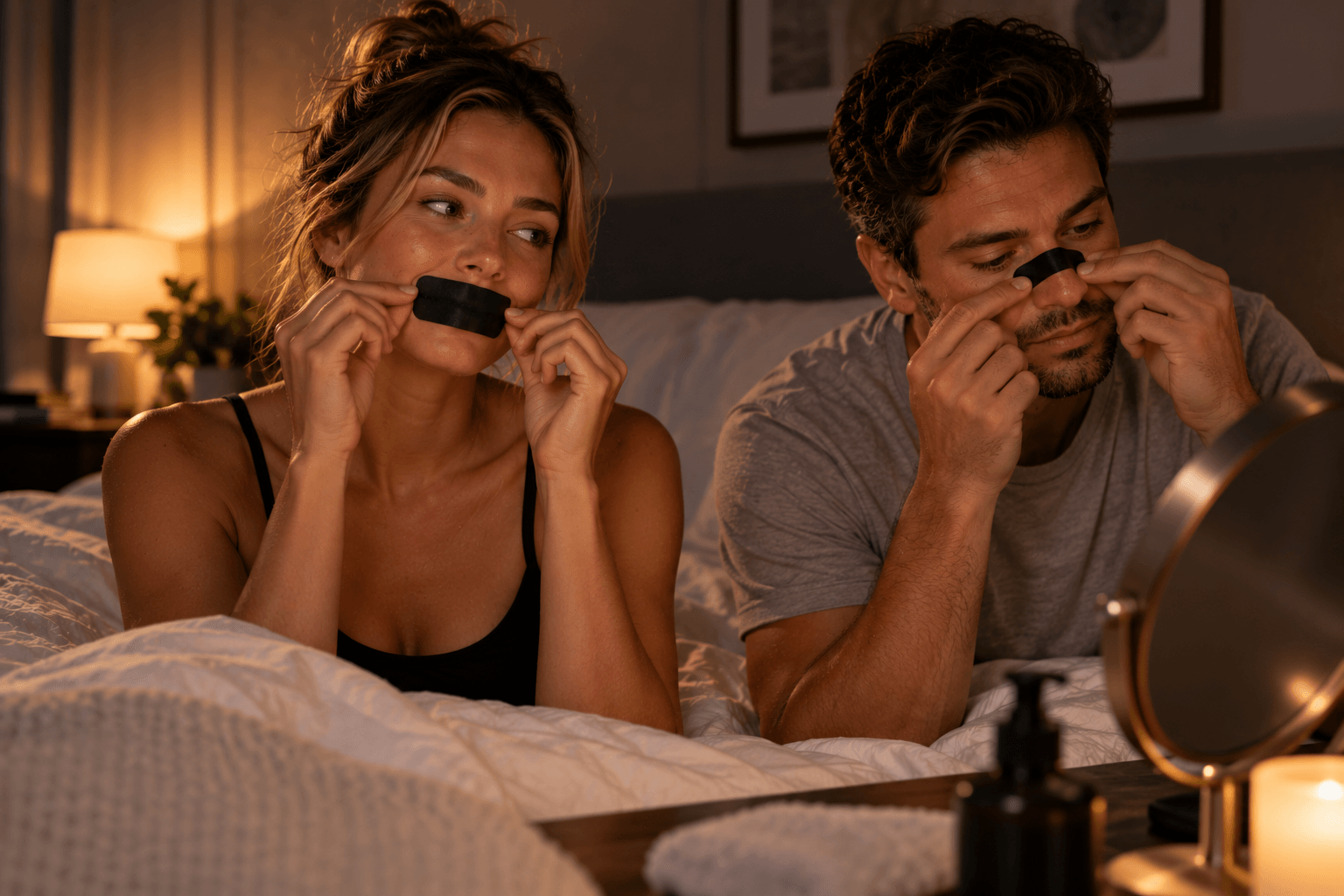
Mouth tape belongs on your pillow, not on your run. Breathing through your nose while you exercise is something many people can learn at easy paces, and the research on it is genuinely interesting. Taping your mouth shut during a workout is a different thing, because it takes away the backup your body reaches for when effort climbs. Here's what the studies show and how to practice nasal breathing in training without tape.
Should you mouth tape while running or working out?
Research: limited (what this means)Mouth taping while running or working out isn't something we recommend. No published study has tested tape during exercise. The exercise research looks at people who choose to breathe through the nose and can open their mouth the moment they need more air. Tape removes that choice, and hard exercise is exactly when you're most likely to need it.
The safety research on mouth tape comes from sleep, and even there the main warning is about airflow. A 2025 systematic review in PLOS One found that four of the ten studies it included warned that keeping the mouth closed, whether with tape, a seal or a chin strap, could pose a serious risk of asphyxiation if the nose is blocked. During a workout your nose doesn't have to be blocked to fall short. It only has to carry less air than your effort demands.
Cleveland Clinic lists difficulty breathing and increased anxiety among the possible side effects of mouth taping, and says it shouldn't be used by people with nasal congestion, chronic allergies, a deviated septum or heart issues. None of this rules out nasal breathing in training. It just means the lips should stay closed by choice, not by tape.
What happens to your breathing as exercise gets harder?
Breathing volume rises steadily with effort, and at some point most people stop breathing through the nose alone. In a 1980 study of 30 healthy adults on an exercise bike, 20 switched from nose-only to nose-and-mouth breathing during moderate exercise, at an average breathing rate of about 35 litres a minute. Five kept breathing through the nose the whole time, and four breathed through both from the start.
The point where people switched was quite consistent for each person but varied a lot between people. The factors most closely tied to it were how hard breathing felt and how much work the nose took. A 2022 review of breathing strategies for runners puts the usual switch at about 40 litres a minute, while noting that people have more flexibility in airway choice than that number suggests.
That switch is a normal reflex, not a failure. Your nose warms, humidifies and filters air, but it's a narrower path than your mouth. As your muscles call for more oxygen, opening the mouth adds a wide second route.
What do studies on nose-only breathing during exercise show?
Studies on nose-only breathing during exercise show that most healthy, active people can keep it up at easy to moderate intensity, with some cost at the top end. A 1995 study of 20 regular exercisers aged 18 to 55 compared nose-only, mouth-only and nose-plus-mouth breathing. Nose-only breathing lowered maximal ventilation, and maximal oxygen uptake fell too, though by less.
The same study had good news for nasal breathers. Breathing through the nose only, every participant could still exercise hard enough to get an aerobic training effect, based on heart rate and percentage of maximal oxygen uptake. The researchers chose people with no nasal polyps or other nasal obstruction, which matters if your own nose tends to run stuffy.
People also adapt with practice. The 2022 review describes a study in which participants kept breathing through the nose up to 85% of their maximal oxygen uptake after a familiarization session, and it notes other work suggesting changes in breathing patterns after an adaptation period. The review's overall view is that nasal breathing is a good fit for low-intensity exercise and for very cold or dry conditions. In its summary table it lists "difficult at high intensities" and "time required for habituation" as the drawbacks.
At hard efforts, using both routes looks fine. A 2025 randomized crossover trial in 12 well-trained cyclists and triathletes found no significant differences in maximal oxygen uptake, peak power or perceived effort between mouth-only breathing and breathing through nose and mouth together, with or without a decongested nose. Our longer guide to nasal breathing during exercise goes through these studies in more detail.
Why is tape riskier during hard exercise than during sleep?
Tape is riskier during hard exercise because your breathing demand can rise far above what it is at rest, and fast. During sleep, your body needs relatively little air, and the people who do well with tape are those who can breathe comfortably through the nose with the mouth closed. During intervals, hills, sprints or heavy lifting, your demand can outrun your nose within seconds.
The 1980 study showed how individual the switch point is, so there's no safe pace you can look up. A blocked nose makes the margin smaller still, and Cleveland Clinic lists congestion, chronic allergies and a deviated septum among the reasons never to tape. The 1995 study only included people free of nasal obstruction, so its reassuring results don't tell you how a stuffy nose would cope.
| Situation | Nose only by choice | Mouth tape |
|---|---|---|
| Easy walk or jog | Usually comfortable for most people | Not studied; no real benefit over closing your lips |
| Steady moderate run or ride | Many people can learn it with practice | Not studied; you lose the option to switch |
| Intervals, sprints, hills, heavy lifts | Most people switch to nose and mouth | Not recommended |
| Stuffy nose, cold or allergies | Skip nasal-only work | Never |
| Sleep, nose clear, no signs of sleep apnea | Not relevant | What mouth tape is designed for |
There's also no sign that tape adds anything. Every benefit linked to nasal breathing in these studies came from people breathing through the nose with their lips closed by choice. A strip of tape doesn't make the nose work better. It only removes the escape route.
How can you practice nasal breathing in training safely?
You can practice nasal breathing in training by keeping your lips closed on purpose at low effort, and letting yourself open them whenever you need to. That gives you the same practice tape would, with none of the risk. Most people find it easiest to start on walks or very easy runs.
Here's a gentle way to build it up:
- Begin with a few minutes of nose-only breathing during a warm-up or an easy walk.
- When the urge to open your mouth gets strong, either slow down or open your mouth. Both are fine.
- Add a few minutes each week if it feels comfortable. The 2022 review notes that habituation takes time.
- Breathe through nose and mouth together for intervals, races and hard sets.
- Skip nasal-only sessions when you have a cold or allergy flare.
Many people find the nose-only pace is a useful check on easy days, because it naturally keeps them from drifting too hard. Our nasal breathing exercises give you some simple drills to try at rest first.
Do nasal strips help if you want to breathe through your nose while exercising?
Nasal strips can make nose breathing during exercise a little easier, and unlike tape they leave your mouth free. In a 1999 study of nine healthy adults, nasal strips lowered resting nasal resistance and delayed the switch to mouth breathing by about 15% during progressive exercise. The authors described the delay as relatively small.
A 2021 meta-analysis found that nasal strips didn't change maximal oxygen uptake, heart rate or perceived exertion in healthy people during exercise. So strips are a comfort tool, not a performance booster. If your nose feels tight on easy runs, a strip is a reasonable thing to try. Our article on nasal strips for exercise covers fit and timing.
Should you keep mouth tape for sleep instead?
Yes. Mouth tape makes the most sense at night, when your breathing is slow and steady and the goal is simply to keep your lips together. The best-known study tested it in mouth breathers with mild sleep apnea: after a week of taping, 13 of 20 participants cut their snoring index by at least half. Researchers haven't studied mouth tape for athletic performance, and that 2022 study measured sleep, not sport.
For people who train hard, a good night's sleep is where tape can earn its place. Our guide to mouth taping for athletes covers how to fit it around a training week, including late sessions and travel. Wait until your breathing has settled after a workout before you tape, and only tape when you can breathe easily through your nose with your mouth closed.
Who should skip mouth tape altogether?
Some people should skip mouth tape at night as well as during exercise. Cleveland Clinic says not to use it with nasal obstruction, nasal congestion, chronic allergies, sinus infections, enlarged tonsils, a deviated septum or heart issues. If you have asthma, including exercise-induced asthma, talk to your doctor first; our article on mouth tape and asthma explains what the research found.
Loud snoring with gasping, choking or pauses in breathing can be a sign of sleep apnea, and that needs a doctor rather than tape. We don't recommend mouth tape for children, including young athletes. See our page on whether mouth taping is safe for the full checklist.
Check this first. Skip mouth tape and see a doctor if you snore loudly, wake up gasping, have been told you stop breathing in your sleep, or can't breathe comfortably through your nose. More on safety
Our pick (paid partner): Titan Bamboo Silk Mouth Tape
For taping at night, after training rather than during it, our pick is Titan Bamboo Silk Mouth Tape. We haven't tested or ranked mouth tapes ourselves, so this is our recommendation based on Titan's own description.
Titan says the strip is bamboo silk rather than kinesiology tape and describes it as soft, breathable and moisture-wicking. It's one oval size, 76 by 38 mm, worn horizontally across the lips, with no printed logo or ink on the side that touches skin. Titan suggests 20 to 30 minutes of daytime practice before the first night, which fits well with the gradual approach above. It says every batch is third-party tested and certified PFAS-free, and that it refunds you if your sleep isn't better after 30 nights.
Read next
- Should you breathe through your nose during exercise?
- 7 things athletes should know about mouth taping at night
- Exercise and sleep: does timing matter?
Common questions
Should you mouth tape while running?
We don't recommend it. Running pushes breathing volume up quickly, and most people switch to breathing through both nose and mouth at moderate effort. Tape takes away that backup. If you want to practice nasal breathing on a run, keep your lips closed on purpose at an easy pace and open them whenever you need more air.
Is it safe to mouth tape while working out?
No study has tested it, so nobody can say it's safe. A 2025 systematic review warns that keeping the mouth closed could pose a serious risk of asphyxiation if the nose is blocked, and hard exercise can push your breathing beyond what the nose comfortably handles. Keep the tape for sleep.
Does nasal breathing during exercise improve performance?
The evidence doesn't show that. A 1995 study found nose-only breathing lowered maximal oxygen uptake, and a 2025 trial in trained cyclists found no performance difference between mouth-only breathing and breathing through both nose and mouth. Nasal breathing is most comfortable at easy to moderate effort.
How do I practice nose breathing during exercise without tape?
Start with walks or very easy runs and keep your lips gently closed by choice. When the urge to open your mouth gets strong, open it, and slow down if you want to stay nasal. A 2022 review suggests nasal breathing suits low-intensity exercise and that habituation takes time.
Can nasal strips help with nose breathing during exercise?
They can make it a little easier. In a 1999 study of nine adults, nasal strips lowered nasal resistance and delayed the switch to mouth breathing by about 15%. A 2021 meta-analysis found no change in VO2max, heart rate or perceived effort, so they help comfort rather than performance.
Can I wear mouth tape at night if I train hard?
Yes, if your nose is clear and you don't have signs of sleep apnea. Mouth tape is a sleep habit for adults whose mouths fall open at night. It isn't a performance aid, and the studies so far haven't looked at athletic results.
Sources
- The switching point from nasal to oronasal breathing
- Comparison of maximal oxygen consumption with oral and nasal breathing
- Breath tools: a synthesis of evidence-based breathing strategies to enhance human running
- Effects of oral, oronasal, and oronasal breathing with a decongested nose during incremental maximal exercise testing of well-trained endurance athletes: a randomized cross-over study
- Nasal dilator strips delay the onset of oral route breathing during exercise
- Does the external nasal dilator strip help in sports activity? A systematic review and meta-analysis
- Breaking social media fads and uncovering the safety and efficacy of mouth taping in patients with mouth breathing, sleep disordered breathing, or obstructive sleep apnea: A systematic review
- Is mouth tape safe to use while sleeping?
- The impact of mouth-taping in mouth-breathers with mild obstructive sleep apnea: a preliminary study
About this article
- Research
- 9 published sources, listed above.
- Evidence
- Limited. How we rate it
- Last checked
- October 18, 2026
- Funding
- Paid partner of Titan Recovery. Their ads are labeled.
- Found an error?
- Tell us. We log fixes on the corrections page.
* This content is for informational and educational purposes only and is not medical advice. It is not intended to diagnose, treat, cure or prevent any disease or health condition. Talk to a qualified healthcare provider about your health.