In short
- The NHS advises removing dentures every night unless your dentist recommends otherwise, citing gum infections, tooth decay and a risk of choking.
- American College of Prosthodontists guidelines say dentures shouldn't be worn continuously, 24 hours a day, to reduce the risk of denture stomatitis.
- In a 2015 study of 524 people aged 85 and over, wearing dentures during sleep was linked to about 2.4 times the risk of pneumonia.
- The ADA says that losing all your teeth can make facial muscles sag and that dentures help fill out the face, so your lips sit differently when dentures are out.
- The ADA notes that dry mouth tends to be worse at night, can be made worse by mouth breathing, and can make dentures harder to keep in place.
- No study has tested mouth tape in denture wearers, so practice while awake, the way you'll actually sleep, and ask your dentist if you're unsure.
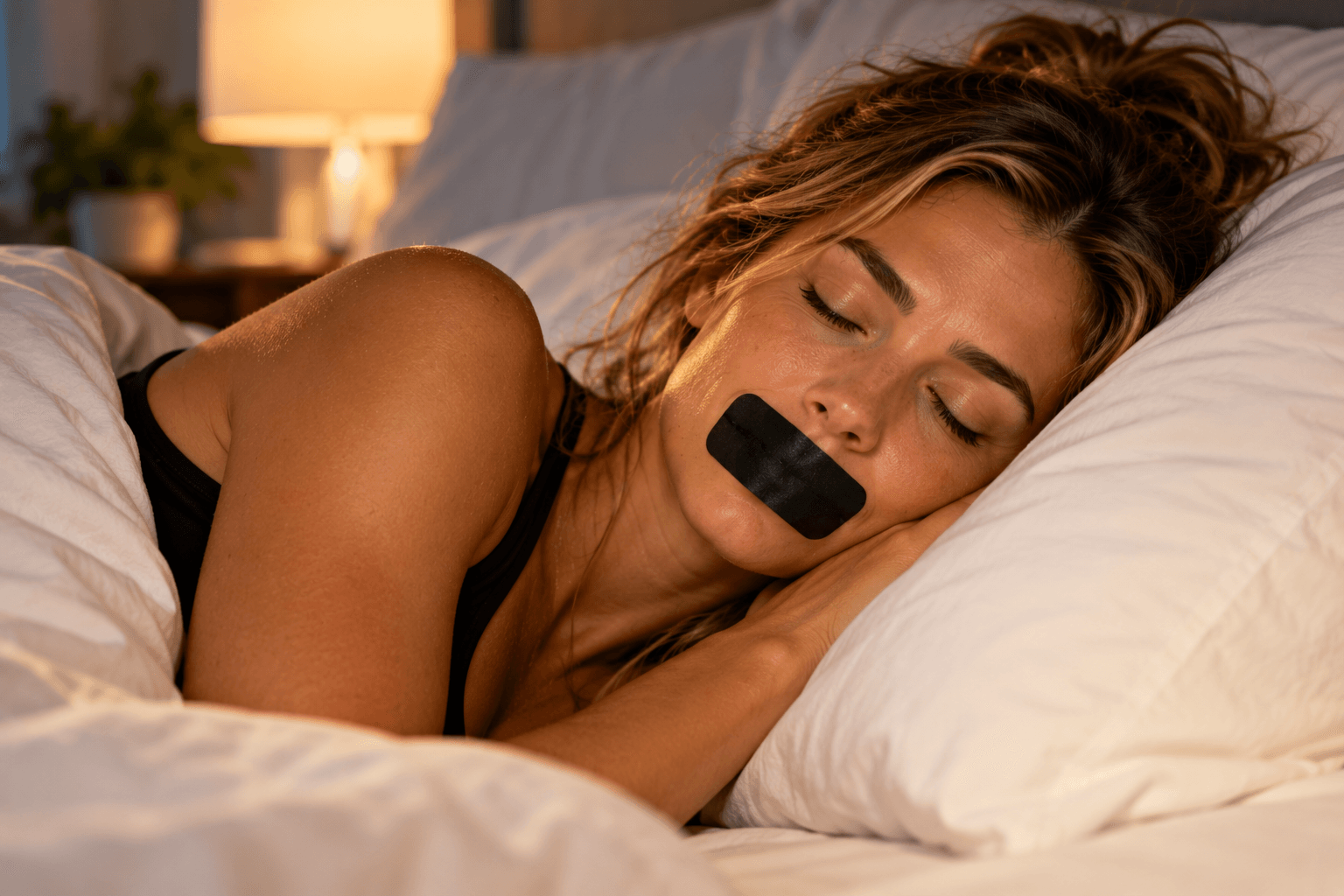
Yes, many denture wearers can use mouth tape, and the usual way is with the dentures out. The NHS advises taking dentures out every night unless your dentist recommends otherwise, so the lips you tape are the lips you sleep with. That changes how the tape sits, which is why a short practice run matters more for you than for most people.
Should you take your dentures out at night?
Most people should take dentures out at night. The NHS advises removing them every night and keeping them in water, a denture bath or an overnight cleaning solution. It says not to wear them overnight unless your dentist recommends it, because trapped food increases the risk of gum infections and tooth decay, and because there's a risk of choking on them while you sleep.
Professional guidelines say much the same. Evidence-based guidelines from the American College of Prosthodontists, developed with the American Dental Association and other groups, say that dentures should not be worn continuously, 24 hours a day, to reduce or minimize denture stomatitis, an inflammation of the tissue under the denture. The guidelines note that the studies give conflicting results, but the recommendation stands.
There's also a link with chest infections in very old people. A 2015 study in the Journal of Dental Research followed 524 people aged 85 and over for three years. Among the 453 denture wearers, those who wore their dentures during sleep had about 2.4 times the risk of pneumonia compared with those who took them out. They were also more likely to have plaque on the tongue and dentures, gum inflammation and yeast in the mouth.
Some people are told to keep dentures in at night for a specific reason. If that's you, follow your dentist's advice and ask them before you add tape.
How do your lips change without dentures?
Your lips lose some of their support when dentures come out. The American Dental Association explains that when you lose all your teeth, facial muscles can sag, and that dentures help fill out the appearance of your face and profile. Take the dentures out and the lips and cheeks fall back toward the gums.
For mouth taping, that has a few practical effects. Your lips may sit further in, fold slightly or close at a different angle than you're used to. A strip that sat flat across your lips with dentures in may crease or lift at the edges without them. The fix is simple: practice with the dentures out, the way you'll actually sleep.
| Situation | What to expect | What to do |
|---|---|---|
| Full dentures out at night | Lips sit further in and may fold | Practice with dentures out; place tape over the middle of the closed lips |
| Partial denture out at night | Remaining teeth still support the lips | Check the lips close comfortably over gaps |
| Told to wear dentures at night | Choking risk if a denture comes loose | Ask your dentist before taping |
| New or immediate dentures | Mouth still healing and changing shape | Wait until your dentist is happy with the fit |
| Dry mouth with loose dentures | Dentures harder to keep in place | Talk to your dentist about fit and dry mouth |
Does dry mouth make dentures harder to wear?
Research: limited (what this means)Dry mouth can make dentures harder to wear. The American Dental Association lists an inability to keep dentures in or poorly fitting removable dentures among the signs of dry mouth. Saliva helps a denture seal against the gums, so a dry mouth can leave it feeling loose and rubbing.
The ADA also says dry mouth symptoms may be worse at night because saliva output reaches its lowest point during sleep, and that the problem can be made worse by mouth breathing. That's where mouth tape fits in. If you wake with a parched mouth and suspect you sleep with your mouth open, keeping your lips closed is one way to cut down on the mouth breathing part.
Medicines are the biggest cause. The ADA says the most frequent cause of reduced saliva is medication, and it cites a review linking urologic medicines and antidepressants with dry mouth in older adults. If your mouth is dry day and night, ask your doctor or pharmacist to review your medicines, and see our guide to medications that cause dry mouth. Tape won't fix a medicine side effect.
How else can you ease dry mouth at night?
Mouth tape is one tool, and it works best alongside other simple steps. The National Institute of Dental and Craniofacial Research suggests drinking plenty of water through the day, sipping water with meals, cutting back on caffeine, chewing sugarless gum or sucking sugarless candy to get saliva flowing, avoiding tobacco and alcohol, and using a humidifier at night. It also mentions saliva substitutes and other products a dentist or doctor may suggest.
The ADA adds that a dentist can reline dentures that fit poorly and may suggest denture adhesive, which matters because a dry mouth and a loose denture tend to make each other worse. Our guide to dry mouth at night remedies covers more options, from bedroom humidity to sleep position.
A simple routine for the evening might look like this: take your dentures out and clean them, brush your gums and tongue, sip some water, set up a humidifier if the air is dry, then put on your tape once you're ready for sleep. Keep a glass of water by the bed in case you wake up thirsty, and keep your dentures somewhere safe, covered in water so they don't warp, as the ADA advises.
What does the research say about mouth tape and dentures?
No study has tested mouth tape in people who wear dentures. The research on mouth tape is small and mostly in younger adults. The most cited study, from 2022, looked at 20 mouth breathers with mild sleep apnea and found their snoring roughly halved when they slept with their mouths taped. It didn't report on dentures.
That means the advice here comes from what we know about dentures and about mouth tape separately, put together sensibly. For more on how taping suits later life generally, including skin and medicines, see mouth tape for older adults.
How do you use mouth tape with dentures out?
Use the same steps as anyone else, with a couple of extras. Take your dentures out, clean them and put them in water or a cleaning solution as your dentist advises. Brush your gums and tongue. The NHS advises brushing your gums, tongue and any remaining teeth with fluoride toothpaste every morning and evening.
Then check your nose. Sit with your mouth closed and breathe only through your nose for a few minutes. If that's hard, don't tape. Next, apply a strip of skin-safe tape over the middle of your closed lips, smoothing it in place without stretching it. Wear it for 15 to 30 minutes while you read or watch TV. Our daytime mouth taping guide explains this practice step.
Pay attention to how your lips feel. If they fold under the tape, try placing it slightly lower on the lower lip or using a slightly narrower piece. Make sure you can open your mouth and pull the tape off easily. Fold over one corner as a pull tab. When you're happy, try it as you fall asleep.
What about skin, lips and removal?
Take care when the tape comes off in the morning, especially if your lips feel dry. Peel it slowly rather than ripping it away. Our guide on how to remove mouth tape has step-by-step help.
Cleveland Clinic lists redness, irritation and allergic reactions on the lips and skin as possible side effects of mouth taping. If you notice sore corners of the mouth or redness that doesn't settle, give your skin a few nights off and read our mouth tape skin irritation guide. Sore spots on the gums are a different matter. The NHS says to see a dentist if your dentures are causing pain.
When should you skip mouth tape or ask your dentist?
Skip mouth tape if you can't breathe comfortably through your nose, or if you have signs of sleep apnea. The NHS lists loud snoring, gasping or choking noises, breathing that stops and starts, and feeling very tired during the day as signs to see a GP about. Cleveland Clinic says you should never use mouth tape if you have nasal obstruction, congestion, chronic allergies, a sinus infection or a deviated septum, among other conditions.
Ask your dentist before taping if:
- you've been told to wear your dentures at night
- your dentures are new, immediate or recently adjusted
- your dentures feel loose or click when you talk
- you have sore spots, red or bleeding gums, or signs of a fungal infection
The NHS suggests seeing a dentist if your dentures click, slip, cause pain or no longer fit well. Those are worth sorting out whether or not you tape. We don't recommend mouth tape for children.
Check this first. Skip mouth tape and see a doctor if you snore loudly, wake up gasping, have been told you stop breathing in your sleep, or can't breathe comfortably through your nose. More on safety
Our pick (paid partner): Titan Bamboo Silk Mouth Tape
If you want to try it, our pick is Titan Bamboo Silk Mouth Tape. We haven't tested or ranked mouth tapes ourselves; this is our recommendation.
Titan says its bamboo silk strip is soft, breathable and moisture-wicking, with no printed ink on the side that touches your skin. It's one oval size, 76 by 38 mm, worn horizontally across the lips, and Titan suggests 20 to 30 minutes of daytime practice before the first night, which suits the dentures-out test above. Titan says every batch is third-party tested and certified PFAS-free, and its 30-night guarantee refunds you if your sleep isn't better after 30 nights.
Read next
Common questions
Can you wear mouth tape with dentures?
Most people can try it, but usually without the dentures in. The NHS advises taking dentures out every night unless your dentist recommends otherwise. If you breathe easily through your nose and have no signs of sleep apnea, practice the tape after your dentures come out so you know how it feels on the lips you'll sleep with.
Should you sleep with dentures in?
Generally no. The NHS says not to wear dentures overnight unless your dentist recommends it, because trapped food raises the risk of gum infections and decay and there's a choking risk. Prosthodontist guidelines also advise against wearing them 24 hours a day. Some people are told to keep them in for a specific reason, so follow your dentist.
Will mouth tape stay on without dentures?
It can, but the fit may feel different. Without dentures, the lips and cheeks lose some of their support, so the lips may sit further in or fold slightly. A flexible tape placed over the middle of the closed lips usually works best. Test it while awake for 15 to 30 minutes before you sleep in it.
Can mouth tape help dry mouth for denture wearers?
It may help if mouth breathing is part of the problem. The ADA says dry mouth tends to be worse at night and can be made worse by mouth breathing. Keeping the lips closed is one way to cut down on that. Medicines are the most common cause of dry mouth, though, so talk to your dentist or doctor too.
Is it safe to sleep with dentures and mouth tape at the same time?
Ask your dentist first. The NHS mentions a choking risk with dentures left in during sleep, and with your mouth taped you can't easily push a loose denture out. If your dentist has a reason for you to wear them at night, check with them before you add tape. No study has looked at this combination.
Do partial dentures change anything?
The same NHS advice applies to partial dentures: take them out at night unless your dentist says otherwise. With a partial out, your remaining teeth still support your lips, so the change may be smaller than with full dentures. Practice while awake to check that your lips close comfortably over any gaps.
Sources
- Dentures (false teeth)
- Guidelines for the care and maintenance of complete dentures
- Denture wearing during sleep doubles the risk of pneumonia in the very elderly
- Dentures
- Xerostomia (dry mouth)
- Denture care and maintenance
- Dry mouth
- Mouth taping: is it safe to use?
- The impact of mouth-taping in mouth-breathers with mild obstructive sleep apnea: a preliminary study
- Sleep apnoea
About this article
- Research
- 10 published sources, listed above.
- Evidence
- Limited. How we rate it
- Last checked
- October 26, 2026
- Funding
- Paid partner of Titan Recovery. Their ads are labeled.
- Found an error?
- Tell us. We log fixes on the corrections page.
* This content is for informational and educational purposes only and is not medical advice. It is not intended to diagnose, treat, cure or prevent any disease or health condition. Talk to a qualified healthcare provider about your health.