In short
- In a 1999 Mayo Clinic study of 10 couples, wives' sleep efficiency rose from 74% to 87% when their husbands' snoring and sleep apnea were treated with CPAP, about 62 extra minutes of sleep a night.
- Cleveland Clinic suggests bringing a partner to a snoring appointment, or using an app or noise-activated voice recorder that tracks snoring.
- A registered trial of silicone mouth tape (NCT06587256) requires each snorer to have a bed partner who can answer questions about their snoring, and calls the partner the often overlooked victim of snoring.
- In a 2022 Healthcare study of 20 mouth breathers with mild sleep apnea, 13 cut their snoring index by at least half on a night with their mouths taped.
- The NHS says breathing that stops and starts, gasping or choking noises, or feeling very tired in the day can be signs of sleep apnoea, which needs a GP rather than tape.
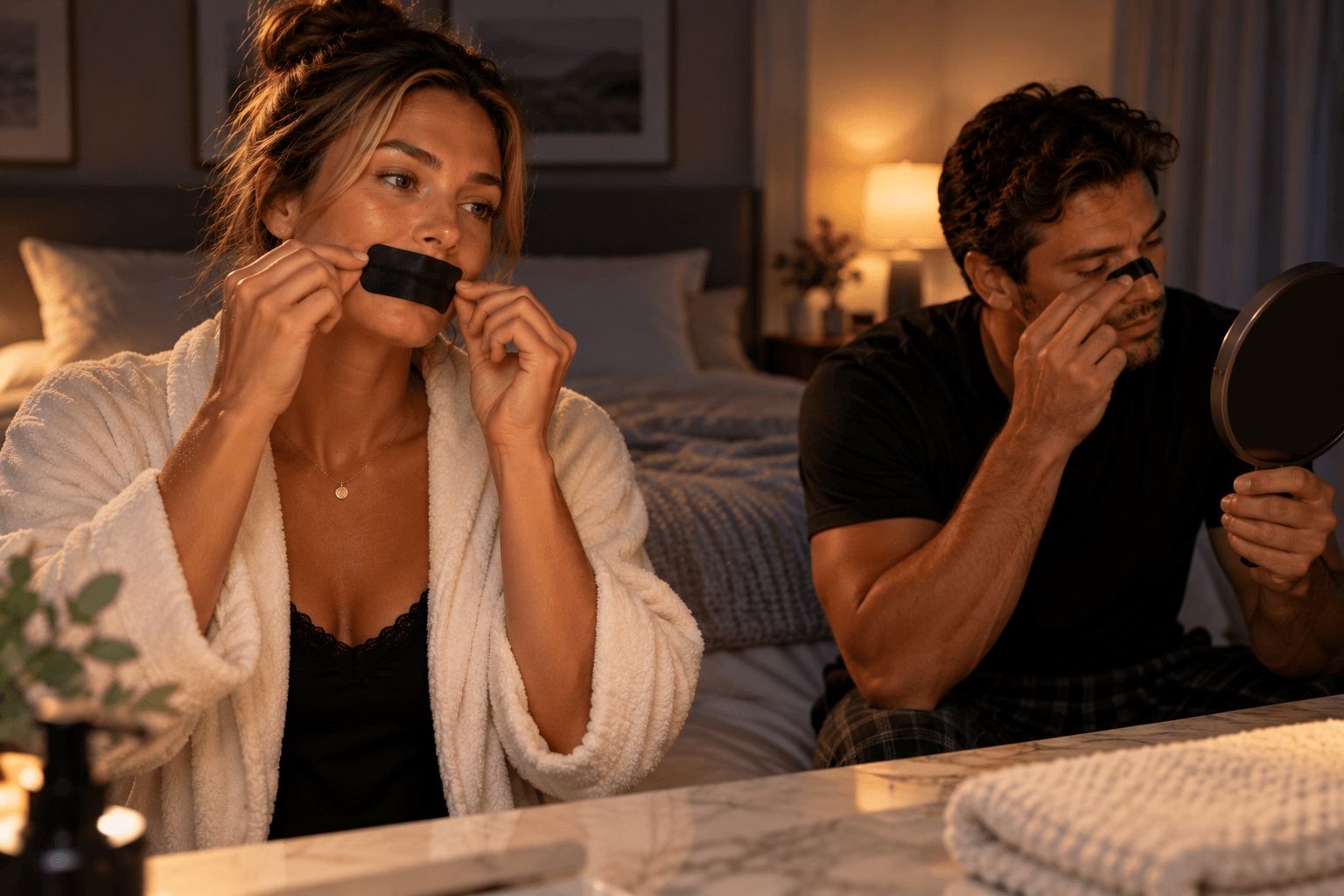
The best way to get your partner to try mouth tape is to make it an invitation, not a complaint. Talk about it in the daytime, let them hear what you hear, check that their nose can carry the load first, and offer to try it alongside them. And if what you're hearing at night includes gasping or pauses in breathing, the first step is a doctor, not tape.
Why does it matter how you bring it up?
How you bring up mouth tape matters because you're really asking two things at once: "you snore" and "would you tape your mouth shut?" Either one can land badly at the wrong moment. Most snorers don't hear themselves, so the news can feel like an accusation, and tape can sound strange until someone explains it. Our guide on how to tell someone they snore covers the first conversation. This one picks up where that leaves off, once snoring is on the table and you think tape might help.
It helps to remember that you have a real stake in this, and that's fair to say out loud. Snoring is a shared problem, and researchers treat it that way. A registered clinical trial of silicone mouth tape, NCT06587256, requires every snorer to have a bed partner who can answer questions about their snoring, and its summary calls the bed partner the often overlooked "victim" of snoring.
What does the research say about partners and snoring?
Research: limited (what this means)The research says partners lose real sleep, and that the snorer's treatment can win it back. In a small 1999 study published in Mayo Clinic Proceedings, researchers ran overnight sleep studies on 10 married couples in which the husband was being tested for sleep apnea. Halfway through the night, the husbands were given CPAP. Their wives' sleep efficiency rose from 74% to 87%, which the authors worked out as about 62 extra minutes of sleep a night. That study treated sleep apnea with CPAP, not snoring with tape, but it puts a number on what your partner's breathing may be costing you.
The tape research is smaller still. In a 2022 study in Healthcare, 20 mouth breathers with mild sleep apnea had a home sleep test, then a second one a week later on a night with their mouths taped. The median snoring index fell by 47%, and 13 of the 20 cut their snoring by at least half. A 2025 systematic review in PLOS One rated all 10 studies it found on mouth taping and similar devices as poor quality, and warned of a serious risk for anyone with a blocked nose. So it's fair to call tape promising for mouth breathers, and not fair to call it a sure thing.
How do you suggest mouth tape without starting an argument?
Choose the moment and lead with "we"
Bring it up over coffee or a walk, not when you've just been woken for the third time. Start with what you both want, such as better sleep and less tension at night, before you mention tape. "I've been sleeping badly and I think we could both do better" invites a conversation in a way that "your snoring is unbearable" doesn't. If snoring has become a sore point, our article on snoring and relationships has more on keeping it kind.
Let them hear it, with permission
Many snorers are surprised by what they sound like. Cleveland Clinic suggests using an app or a noise-activated voice recorder that tracks snoring, and recommends bringing a partner to appointments to describe it. Ask before you record, then listen together. A recording also gives you a baseline, so if your partner does try tape you'll have something real to compare against, which beats arguing about whether it "seemed quieter." Our guide to tracking mouth tape results shows how to keep simple notes.
Explain what tape is, and what it isn't
Your partner may picture duct tape across the whole face. Modern mouth tape is usually a small, soft strip that holds the lips gently together so you breathe through your nose. Show them one. A product like Titan Bamboo Silk Mouth Tape is an oval bamboo silk strip worn across the lips, which looks a lot less dramatic in your hand than it sounds in conversation. Be honest that it's an experiment, not a cure.
Make the nose test the first step
The nose test is where every mouth tape conversation should start, because it puts safety first and gives your partner an easy, non-committal thing to try. Ask them to close their lips and breathe through the nose for a few minutes while relaxing. The NCT06587256 trial uses a similar check, requiring participants to tolerate breathing through the nose with the tape on for at least 3 minutes. If they can't do that comfortably, tape isn't for them right now. Our nose test walks through it.
Offer to go first, or go together
Offering to wear the tape first takes the spotlight off the snorer. You show it's comfortable, you take it off easily in the morning, and nobody feels like a test subject. Our guide to mouth tape for couples covers trying it side by side, from practicing on the sofa to agreeing on a hand signal for the night.
Keep the stakes low
Agree on a short trial with a clear exit. A few short practice sessions while you watch TV, then a handful of nights, then a check-in. If your partner hates it, that's an answer too. People who feel they can stop at any time are far more willing to start. Our first-week plan is a good shared script.
What should you say, and what should you avoid?
Small changes in wording make a big difference. Here's a quick guide.
| Try saying | Instead of | Why it helps |
|---|---|---|
| "I've been sleeping badly. Can we look at it together?" | "Your snoring is keeping me up." | Makes it a shared problem, not a charge |
| "Want to hear a clip? It surprised me." | Playing a recording without asking | Keeps trust; the recording becomes a tool, not a weapon |
| "Can you breathe through your nose comfortably for a few minutes?" | "Just tape your mouth tonight." | Puts safety first and starts small |
| "I'll try it first." | "You should try this thing I saw online." | Shows it's harmless and removes the spotlight |
| "Let's try it for a few nights and decide together." | "You have to stop snoring." | A clear exit makes yes easier |
What if your partner says no?
If your partner says no, take it at face value and move on to other options. Some people find tape uncomfortable, and Cleveland Clinic lists anxiety among its possible downsides, especially for people who have trouble breathing through the nose. If that's the hesitation, our article on mouth taping anxiety has gentle ways to ease in, but don't push.
There are plenty of other places to start. The NHS lists sleeping on your side, losing weight if you're overweight and not drinking too much alcohol among things that can help with snoring. For snoring caused by the mouth falling open, it lists a chin strap to hold the mouth closed, and for blocked or narrow nasal airways it lists nasal dilators or strips. It also suggests the non-snoring partner try earplugs. Our guide to sleeping next to a snorer covers your side of the bed.
When does your partner need a doctor before tape?
Your partner needs a doctor first if their snoring comes with signs of sleep apnea. The NHS lists breathing that stops and starts during sleep, gasping, snorting or choking noises, and always feeling very tired in the day as the main symptoms, and says it helps to bring someone who has seen the symptoms to the GP. As the bed partner, that someone is probably you. The NHS also notes that untreated sleep apnoea can be hard on a partner and put a strain on the relationship.
Cleveland Clinic says mouth tape shouldn't be used with nasal obstruction or congestion, chronic allergies, sinus infections, enlarged tonsils, a deviated septum or heart issues. If your partner is pregnant, has a lung condition or takes sedating medicines, they should ask their clinician first. We don't recommend mouth tape for children. Our list of sleep apnea warning signs is worth reading together.
Check this first. Skip mouth tape and see a doctor if you snore loudly, wake up gasping, have been told you stop breathing in your sleep, or can't breathe comfortably through your nose. More on safety
Our pick (paid partner): Titan Bamboo Silk Mouth Tape
If your partner is willing to try, our pick is Titan Bamboo Silk Mouth Tape. We haven't tested or ranked mouth tapes ourselves; this is our recommendation, and it isn't a proven fix for snoring.
It suits a hesitant first-timer for a few reasons. Titan says the strip is bamboo silk, soft, breathable and moisture-wicking, in one oval size worn horizontally across the lips, with no printed ink on the side that touches skin. Titan says its SilkSeal adhesive is made to grip through stubble and full beards without tugging hair or leaving residue, which helps if your partner has facial hair.
Titan suggests 20 to 30 minutes of daytime practice before the first night, which fits neatly with the "try it on the sofa first" approach above. It says every batch is third-party tested and certified PFAS-free. And Titan's 30-night guarantee refunds you if your sleep isn't better after 30 nights, which makes the low-stakes trial you agreed on easier to say yes to. If your partner would rather start with something they can hold in their hand before committing, ordering a small supply of Titan's mouth tape to look at together is a gentle first step.
Read next
- 6 tips for couples trying mouth tape together
- How to tell someone they snore (without starting a fight)
- How to start mouth taping: your first week
Common questions
How do I ask my partner to try mouth tape?
Pick a calm daytime moment, not 3am. Lead with how you both sleep rather than how loud they are, share a short recording if they want to hear it, and offer to try the tape yourself first. Make it an experiment you can both drop, not a demand.
Should I record my partner snoring?
Only with their agreement. Cleveland Clinic suggests an app or noise-activated voice recorder that tracks snoring, and recommends bringing a partner to appointments to describe it. A recording you both listen to can turn a vague complaint into something concrete, and it gives you a before and after to compare.
What if my partner refuses to try mouth tape?
Respect it. Some people find tape uncomfortable or anxiety-provoking, and Cleveland Clinic lists anxiety among its possible downsides. You can still suggest side sleeping, which the NHS recommends for snoring, try earplugs yourself as the NHS also suggests, and encourage a doctor visit if you notice warning signs.
Is mouth tape safe for my partner?
It's only reasonable for adults who breathe easily through the nose. Cleveland Clinic advises against it with nasal obstruction or congestion, chronic allergies, sinus infections, enlarged tonsils, a deviated septum or heart issues. Gasping, choking or pauses in breathing are signs of possible sleep apnea, which needs a doctor first.
Does mouth tape actually stop snoring?
It can reduce snoring in mouth breathers, but the evidence is small. In a 2022 study of 20 mouth breathers with mild sleep apnea, 13 cut their snoring index by at least half on a taped night. A 2025 review rated the studies as poor quality and called for larger trials.
Should we both try mouth tape at the same time?
Trying together often makes it feel less like a verdict on the snorer. Each of you should check your own nose first and practice in the daytime. If only one of you snores, the other can still wear a strip for solidarity or simply act as the listener who notices changes.
Sources
- The effect of snoring and obstructive sleep apnea on the sleep quality of bed partners
- Study to Examine the Effect of Silicone Mouth Tape on Snoring and Mild Sleep Apnea
- Snoring
- Snoring
- Sleep apnoea
- The impact of mouth-taping in mouth-breathers with mild obstructive sleep apnea: a preliminary study
- Breaking social media fads and uncovering the safety and efficacy of mouth taping in patients with mouth breathing, sleep disordered breathing, or obstructive sleep apnea: A systematic review
- Is Mouth Tape Safe To Use While Sleeping?
- Titan Bamboo Silk Mouth Tape
About this article
- Research
- 9 published sources, listed above.
- Evidence
- Limited. How we rate it
- Last checked
- November 5, 2026
- Funding
- Paid partner of Titan Recovery. Their ads are labeled.
- Found an error?
- Tell us. We log fixes on the corrections page.
* This content is for informational and educational purposes only and is not medical advice. It is not intended to diagnose, treat, cure or prevent any disease or health condition. Talk to a qualified healthcare provider about your health.